
Artist Bio
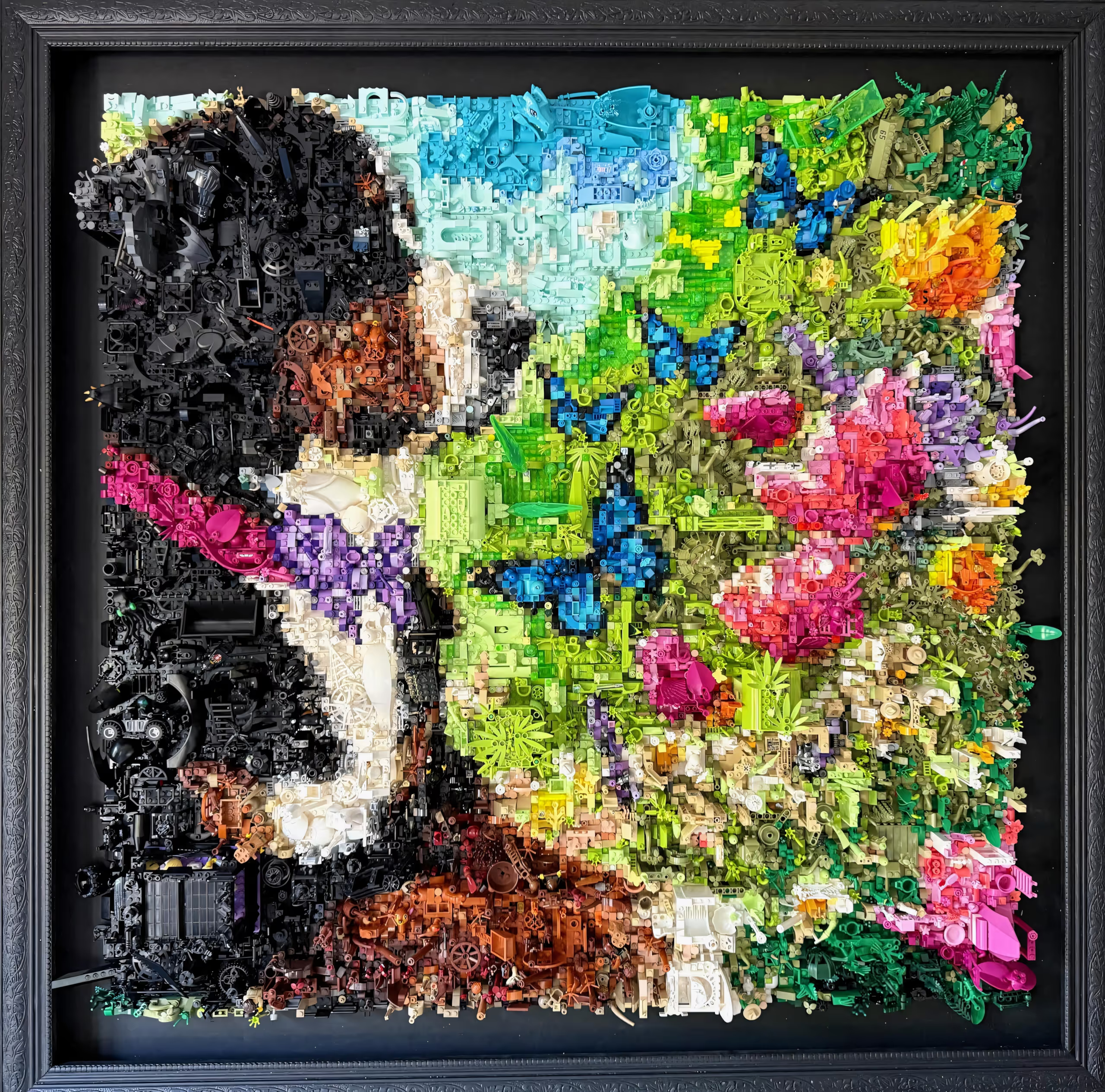
Andrew Schmidt is a contemporary artist who transforms thousands of individual LEGO elements into large-scale, three-dimensional artworks. Working outside the conventional boundaries of both painting and sculpture, Schmidt has developed Dimensional Impressionism, a self-defined approach in which depth is intentionally constructed with color to sculpt images through shadow and hue.
Schmidt intentionally leaves the modular structure of the medium visible rather than disguising it. From a distance, the elements resolve into recognizable imagery; as viewers move closer or change their vantage point, the image breaks apart into a complex physical landscape of color, texture, shadow, and form.
Schmidt's practice is rooted in an interest in perception and perspective. His work asks viewers to reconsider the assumption that a single viewpoint provides a complete understanding of what they are seeing. Physical dimensionality is therefore not simply a technical characteristic of the work—it is fundamental to its meaning. The works reward movement, closer observation, and a willingness to spend time with each piece.
Animals have become an important subject within Schmidt's practice, allowing him to explore the relationships between humans and the other beings with whom we share the world. His animal works range from intimate portraits of companionship to explorations of instinct, vulnerability, and the unknowable perspective of another living creature.
Beyond the individual subject, Schmidt's work reflects a broader philosophy: that complexity does not preclude meaning, and that order can emerge from seemingly disconnected parts. By transforming a familiar material into an unexpected artistic medium, he invites viewers to reconsider both the work itself and the assumptions through which they experience the world.
Based in the United States, Schmidt continues to expand Dimensional Impressionism through original artworks, exhibitions, installations, and an evolving exploration of what dimensional imagery can become.