
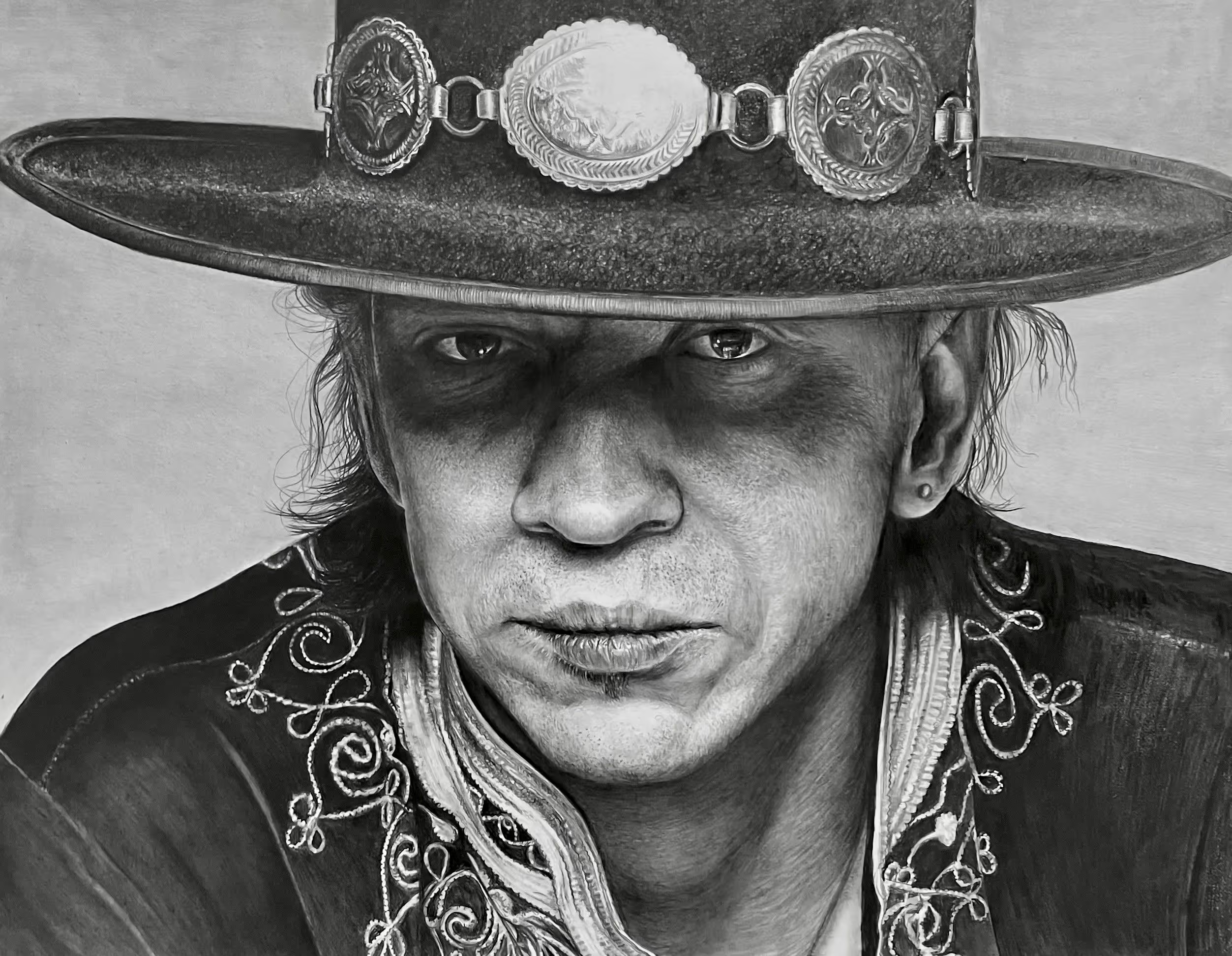
Stevie Ray Vaughn
When I was in grade school and high school, I did a lot of art. I like to think it offered me an incredible foundation for what would come much later. In high school, I studied under Walt Bartman, doing oil painting primarily. I was accepted into the Maryland College of Art and Design on a figure drawing scholarship program that they offered to high school students when I was 16. After high school, I went on to pursue my other passion — helping people. I’ve spent the last 25 years working as a psychotherapist. Sometime in the middle of all of that, I had kids (twins), and eventually came back to drawing in 2017. What I do now is primarily self-taught, though I do feel my training and education as a child have created an invaluable foundation for my work today. I’ve watched countless hours of slowed-down YouTube videos and tutorials, and have spent thousands of hours drawing, practicing, and improving. It’s been a wonderful and challenging journey, and I’ve loved every minute of it! My goal moving forward is to continue to learn and challenge myself as I transition to art full-time. I feel the next step is to get my name out there to the art world. I have just recently started applying to calls via café, and have been accepted into a small handful of international juried shows. My goal as an artist is the same as my goal as a human — connection. I work to find the place where we all meet; that place where our differences recede, and we can settle in. That’s why I draw, to find that snapshot moment where someone can look at my art and go, Oh, yes. I know that feeling.
My artistic practice centers on portraiture—on drawing out the unseen essence of a subject and translating it through the delicate control of graphite. I explore the quiet power of detail—each mark is an invitation to slow down, to look closer, and to witness what is often overlooked. Every drawing is a form of deep listening, an act of attention that honors the emotional and psychological presence of the individual.
I believe hyperrealism, when pursued with discipline and sensitivity, becomes more than a replication of the visible world—it becomes a mirror, a bridge, and sometimes, a wound made visible. I’m fascinated by the complexity of the human face and the subtle interplay of light, texture, and expression that gives a portrait its emotional charge. As a psychotherapist, I’m naturally attuned to nuance, which shapes my artistic philosophy: that realism can reveal as much about the internal world as the external one. It allows me to build tonal depth slowly, almost sculpturally, honoring the patience, presence, and attention each subject deserves.
My style has evolved over the last eight years to a refined form of realism that balances technical control with expressive intent. I see art as a language, and my goal is to create a sense of atmosphere and feeling. I’m currently exploring new directions, including the integration of charcoal for its expressive depth and contrast.
My goal as an artist is the same as my goal as a human — connection. I work to find the place where we all meet; that place where our differences recede, and we can settle in. That’s why I draw, to find that snapshot moment where someone can look at my art and go, Oh, yes. I know that feeling.
My artistic practice centers on portraiture—on drawing out the unseen essence of a subject and translating it through the delicate control of graphite. I explore the quiet power of detail—each mark is an invitation to slow down, to look closer, and to witness what is often overlooked. Every drawing is a form of deep listening, an act of attention that honors the emotional and psychological presence of the individual.
I believe hyperrealism, when pursued with discipline and sensitivity, becomes more than a replication of the visible world—it becomes a mirror, a bridge, and sometimes, a wound made visible. I’m fascinated by the complexity of the human face and the subtle interplay of light, texture, and expression that gives a portrait its emotional charge. As a psychotherapist, I’m naturally attuned to nuance, which shapes my artistic philosophy: that realism can reveal as much about the internal world as the external one. It allows me to build tonal depth slowly, almost sculpturally, honoring the patience, presence, and attention each subject deserves.
My style has evolved over the last eight years to a refined form of realism that balances technical control with expressive intent. I see art as a language, and my goal is to create a sense of atmosphere and feeling. I’m currently exploring new directions, including the integration of charcoal for its expressive depth and contrast. I’ve just completed my largest piece to date—a graphite portrait measuring three feet tall and two feet wide—which has expanded both my physical and emotional engagement with the medium, allowing space for story, intimacy, and connection.
My goal is to create drawings that don’t simply replicate life but evoke it—quietly, powerfully, and with honesty.

Stick Dance
Subodh Maheshwari was born in Aligarh, Uttar Pradesh, North India where she learned folk art and classical music. She passionately believes: “In the threshold of my life, my present is the window to the past and a key to the future”. She acquired her degrees and studied art at Agra University, California State University of Fullerton, and the University of California Irvine. Subodh has won numerous awards, including the Regional Fellowship Award at UCI in 1986, the Bharat Gaurav Award in India in 2015, and the 60 Masters Award in 2017, 2018, and 2019. She is also registered in Marquis’ “Who’s Who in America”, the standard in biographical information. Her paintings have also won awards in a variety of categories including landscape, open, all women, nature, elements, seasons, and abstract.
Subodh is a diversified artist who enjoys telling stories through her artwork, whether it is through landscape, flowers, or abstract art. Her art is a fusion of Eastern symbolism and Western composition, influenced by 16th and 17th century Rajasthani and Mogul art, and accented by poetry, passages, and phrases in Hindi, Sanskrit, and English. She admires Georgia O’Keeffe for her floral influence, and Frida Kahlo for her courage. Whether it is the serene beauty of nature, her spirituality, or the current political climate, she finds inspiration. Having a life shared between India and America, she sees the beautiful similarities, like love which transcends all borders. Highly individual in her style, her works are described as emotional, mysterious, personal, spiritual, and humorous.
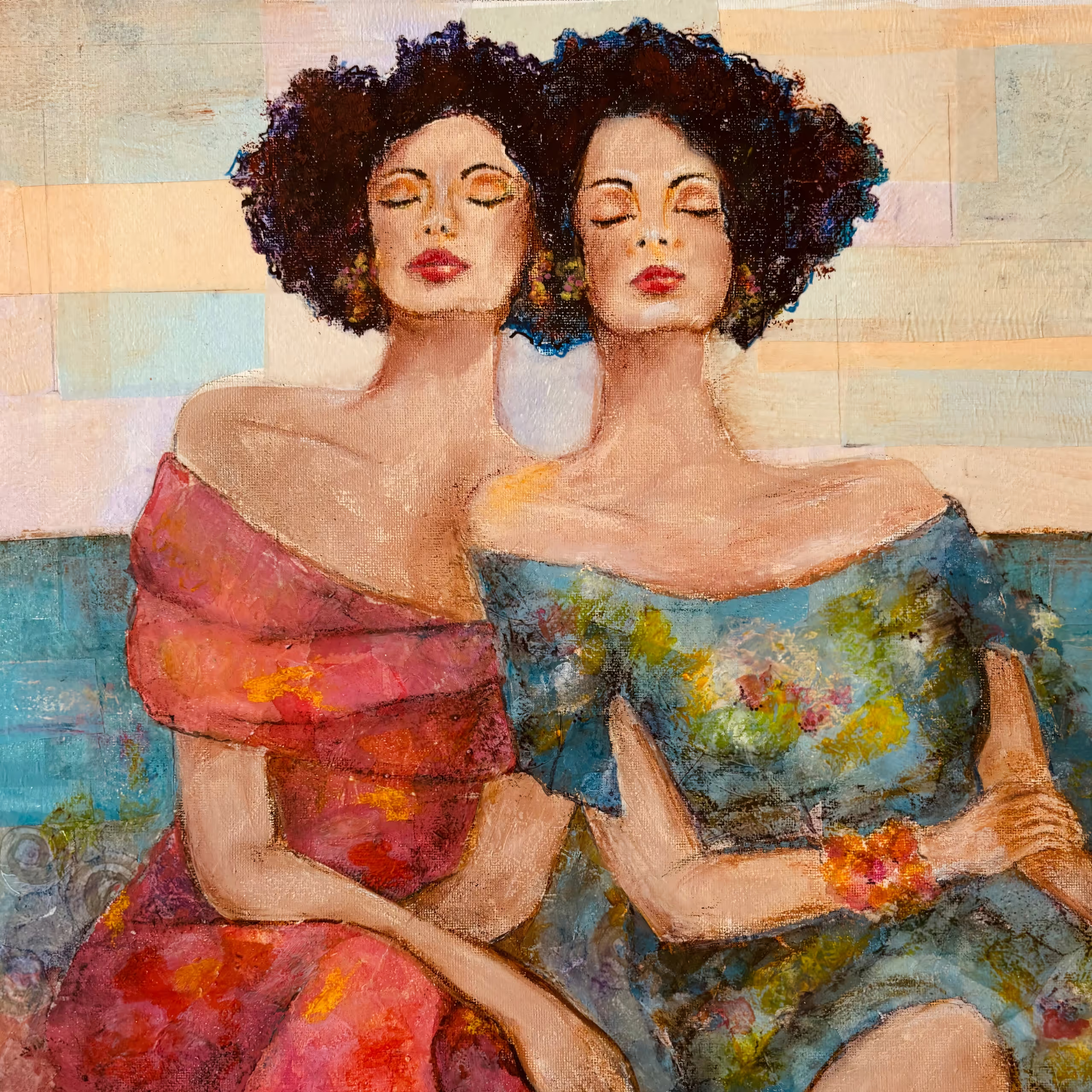
Still Here
Jody Nelson is a Palm Desert, California-based mixed media artist whose layered, luminous paintings have been featured in juried exhibitions and both group and solo shows, with original work available through Saatchi Art and held in private collections across the United States and Canada. Drawn to expressive color, richly built-up surfaces, and the emotional resonance of still moments, her paintings transform the quiet textures of everyday life into bold, joyful works. Working in acrylic, pastel, and collage, Nelson builds each painting through layers of torn paper and mark-making, creating surfaces that carry their own history before the figure arrives. Each piece balances energy with calm — an ongoing invitation to pause, to notice, and to find beauty in the ordinary.
I paint women in the quiet moments — not the moments the world sees, but the ones that happen in between. The exhale after the effort. The stillness that arrives when we finally stop moving long enough to feel something.
My work is built in layers — torn paper, acrylic, pastel, and mark-making — each surface carrying its own history before the figure arrives. The women I paint are never performing. They are resting, remembering, belonging to themselves and to each other. Emotion, for me, lives in the body before it reaches the face. In shoulders that relax. In feet sinking into warm sand. In a chin lifted toward the sun.
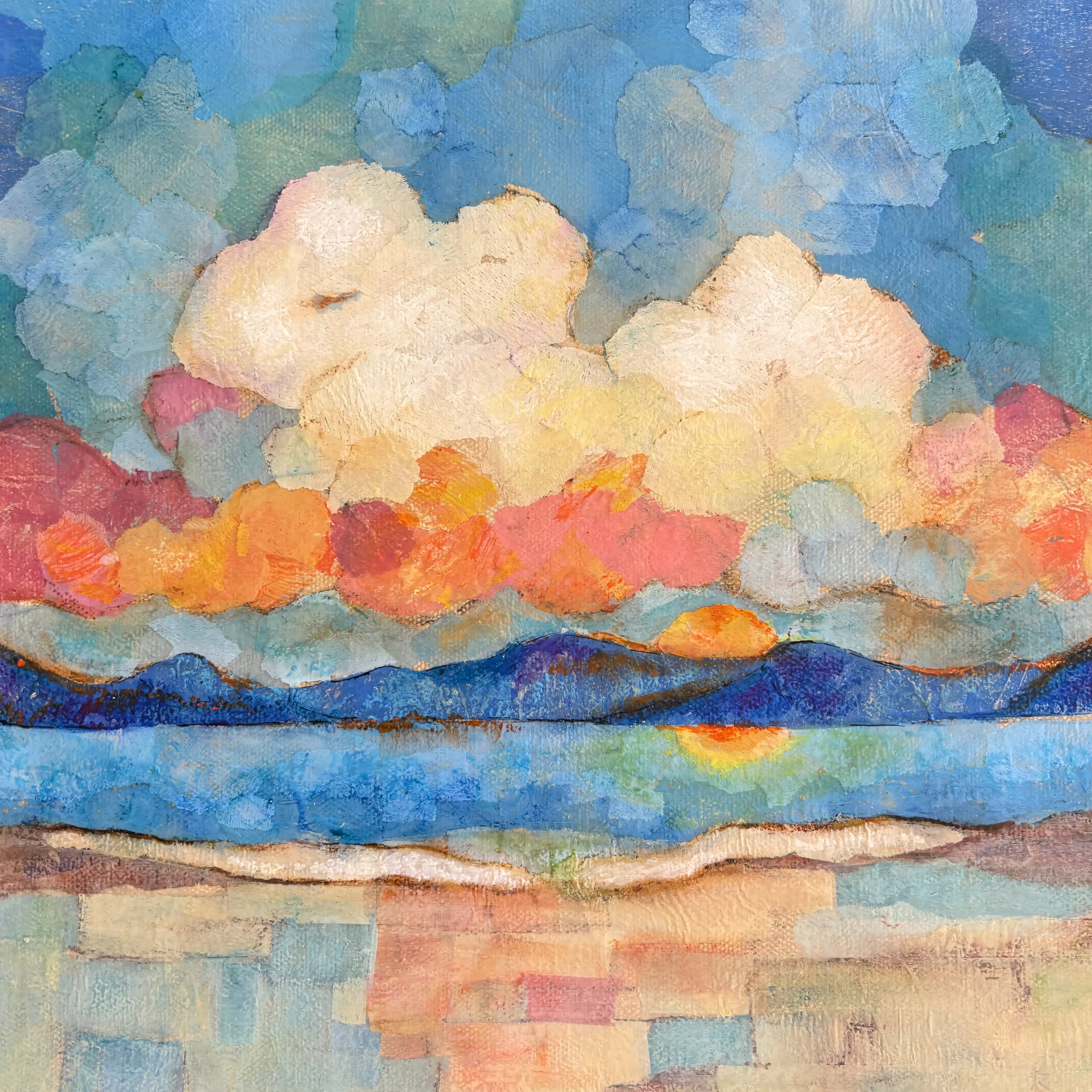
Still Home
Jody Nelson is a Palm Desert, California-based mixed media artist whose layered, luminous paintings have been featured in juried exhibitions and both group and solo shows, with original work available through Saatchi Art and held in private collections across the United States and Canada. Drawn to expressive color, richly built-up surfaces, and the emotional resonance of still moments, her paintings transform the quiet textures of everyday life into bold, joyful works. Working in acrylic, pastel, and collage, Nelson builds each painting through layers of torn paper and mark-making, creating surfaces that carry their own history before the figure arrives. Each piece balances energy with calm — an ongoing invitation to pause, to notice, and to find beauty in the ordinary.
I paint women in the quiet moments — not the moments the world sees, but the ones that happen in between. The exhale after the effort. The stillness that arrives when we finally stop moving long enough to feel something.
My work is built in layers — torn paper, acrylic, pastel, and mark-making — each surface carrying its own history before the figure arrives. The women I paint are never performing. They are resting, remembering, belonging to themselves and to each other. Emotion, for me, lives in the body before it reaches the face. In shoulders that relax. In feet sinking into warm sand. In a chin lifted toward the sun.

Still Life In Blue
Joanne M. Meurer is the creative director and founder of ReInvent Strategies, Inc., a boutique marketing and branding firm located in NYC. She brings over two decades of corporate branding and strategic marketing expertise to New York City’s entrepreneurial landscape. As Creative Director, she ensures businesses authentically represent themselves in print and online, fostering their unique identity.
Joanne’s impact extends beyond marketing; her Acrylic Mixed Media works have been displayed at several galleries across NYC and Brooklyn, solidifying her presence in the artistic community.
Joanne’s commitment to the arts is evident through her involvement with BWAC and “Art on The Terrace,” which demonstrate her dedication to fostering artistic expression. Currently represented by NYC Arts Empire, her artwork has been displayed on the NASDAQ Billboard in Times Square, Big Screen Plaza in Midtown Manhattan, and several KIOSK throughout NYC, further underscoring her significance in both the marketing and art spheres.
I am Joanne Meurer, an artist who thrives on the interplay of mood, music, and materiality. My creative journey is a fusion of passion and precision, where the rhythms of rock and jazz-funk electrify my canvas, igniting a symphony of color and texture.
As a graphic designer by trade, my work is defined by meticulous detail and deliberate composition. Yet, beneath the surface lies a wild spontaneity—an untamed energy that pulses with the complex cadences of electric guitar solos and soulful jazz melodies.
Music is my muse, infusing each piece with an ethereal vitality that transcends the ordinary.
Whether inspired by the pulsating beats of global events or the intimate whispers of my innermost thoughts, my art reflects the world as seen through the lens of my consciousness.
Exploring beyond the confines of traditional art, I embrace the challenge of sculpting three-dimensional forms that mirror the depth of my personality and aspirations. Like a master craftsman, I mold form and substance into expressions of dimensionality, inviting viewers to journey beyond the surface and uncover the hidden layers beneath.
When you encounter my work, what may initially appear as a distant tableau soon reveals itself as a vibrant tapestry of complexity and nuance. With each brushstroke and every note, I invite you to delve deeper into the kaleidoscope of my soul—a realm where light and shadow dance in harmony, where chaos and order merge to form a symphony of expression.
In every moment, in every creation, I rediscover myself—a seeker, a storyteller, a dreamer of boundless possibilities. Through my art, I invite you to join me on this timeless voyage of discovery, where the journey is as infinite as the creative spirit itself.

Stone Lantern With Koi Fish
Yue Zeng is a Chinese-American self-taught artist, mother, and wife, who has been living in the United States since 2008 and currently resides in Woodbury, Minnesota. Zeng’s artistic practice focuses on oil painting, with her subjects mainly being mythical creatures and imaginary landscapes. With a style between impressionism and fantasy, she explores the vividness of their spirit in saturated colors and organic forms. Zeng’s interest in the arts started in elementary school, sparking her desire to create later in life. In her twenties, she obtained her Master in Science from SUNY College of Environmental Science and Forestry in Syracuse, New York. In 2017 due to physical complications, Zeng had to leave the chemistry industry. Transformed by the experience, she decided to revisit her art practice and make it her career regardless of the obstacles she would face. Since then, Zeng has flourished in her artistic expression, finding her true passion in oil painting. Although Zeng explores other painting mediums such as gouache, pastel, and digital, oil and canvas feel the most natural. This medium allows her to relax and be free with the changeability of the material and exploration of color within the subjects she paints.
My paintings are an outlet to express the imagination I have inside my head that I can not put into words. After trying many mediums, I always find myself coming back to paint and brushes. In my current artistic practice, I use oil paint and mainly create portraits of mythical creatures and animals transfixed in the shifting colors of seascapes and landscapes. There is a natural spirit and magic to these creatures and their energy draws me in. Choosing to paint these creatures as real living wildlife rather than abstractions, I use bold and vivid colors to express the imagination intertwined with reality, finding magic between the seams. Using a saturated color palette, I create bold and striking imagery, contrast between foreground and background, subject and landscape, and light and darkness. Weaving their bodies and the surface of the landscape into each other through organic forms and flowing brush strokes, I find beauty, strength, and innocence in these creatures that reflect my inner world.

Stoner
Anna Mathai is a multidisciplinary artist based in San Francisco with a practice spanning from mixed media and painting to sculpture, decorative residential wall installations, and writing. She creates sculptural and textured works that use color, light, texture, and shadow to tell her story, and frequently works with plaster, textile, and metal. Her goal is to create things that hold some strange magic. It’s why she likes to experiment with and create new methods (like her “canvas kintsugi” and hardened silk origami). She makes works that interact with their viewers and the light around them, reflecting, shifting colors, and jumping off of the wall to mingle art and enjoyment, to transcend viewing into experiencing. She feels that the aesthetics (and a touch of whimsy) are paramount. However, on the “series level,” her work often references deeper themes from her life, such as rebellion, feminism, “otherness”, and the immigrant experience. Her work, however, is not overtly political. In her mind, her art generally reflects on boundaries, both real and imagined and blurs them.
Mathai was born in the UK to Indian parents but spent most of her childhood in the rural Deep South. She obtained a Bachelor of Arts from Rice University after graduating from the Louisiana School for Math, Science, and Arts, then went to medical school, and eventually law school, later practicing as an entertainment lawyer. Since pursuing her art professionally, her work has been featured in international art magazines and exhibited nationwide. In her other time, she writes lyrics and screenplays, enjoys nature with her Australian Shepherd, and Cowboy, and tests jokes on friends and family.
I create sculptural and textured works that use color, light, texture, and shadow to tell my story, and frequently work with plaster, textile, and metal. I want to create things that hold some sort of strange magic. It’s why I like to experiment with new methods and create works that interact with their viewers and the light around them, jumping out of the canvas to mingle art and enjoyment, to transcend viewing into experiencing. I feel that the aesthetic (and a touch of whimsy) is paramount, though on the “series level,” my works sometimes reference deeper themes from my life, including those of rebellion, feminism, and the immigrant experience. My work is not overtly political, and it would be unlike me to have one meaning for any single work—in fact, the exploration of dualities and the blurring of them is conceptually central to most of my art. Even in my poetic writing, I find beauty in the multiplicity and ambiguity of meaning. So, I prefer to avoid prescribing meaning to each work and let the viewer interact with it themselves, adding to the art with their own interpretation. It’s a sort of acceptance of all meanings: each one is true as it applies to you—I call it my “quantum art” philosophy. All that being said, in my mind, my work generally reflects on boundaries, both real and imagined, and blurs them.

STOP
Wendee Yudis is a Serigraph Mixed Media Artist whose paintings and prints have been exhibited in solo and group shows in galleries in NYC, Chicago, and Philadelphia since the mid-1990s. Solo exhibitions include Ceres Gallery in NYC, Black Moth Gallery in Phila, and Gallery 1633 in Chicago. A selection of group exhibitions includes The Albright/Knox Museum in NY, Manhattan Graphics Center in NYC, Philadelphia Art Alliance in PA, James Oliver Gallery in Phila, PA, University of Pennsylvania: Penn Medicine in PA, CFEVA in PA, InLiquid in PA, DaVinci Art Alliance in PA, and The Trenton Museum in NJ. Select work was in a national juried competition in the Phoenix Gallery in NYC by Thelma Golden, then curator of The Whitney Museum of American Art.
Wendee Yudis received an MFA in Printmaking and Painting from Pratt Institute and a BFA in Printmaking and Photography from The School of the Art Institute of Chicago. She also studied archaeology at The Hebrew University of Jerusalem and photography at Richmond College in London.
In addition to being a visual artist, Wendee works as a Graphic Designer and Art Director. Since the mid-1990s she has worked in agencies and non-profits in NYC and Philadelphia.
My art turns the definition of femininity on its head.
It examines and questions women’s roles in the world as dictated by social constructs: the ones imposed upon us – obedient child, wife, and daughter – and the ones we step into voluntarily – boss, lover, and vixen.
I use humor to explore the depths of these ideas. Womanhood cannot and should not be confined to one definition. Why do we have to be vixens or victims? Can we be both? My work explores the paradox of the powerful vs. the powerless in a manner that is both playful and sexual. The women in my work become icons who reoccur in different contexts and combinations. In this way, my work is layered with meaning. I look at the words we use to define masculinity and femininity and play with typography and context. For example, why is a bossy man synonymous with executive leadership while a bossy woman is a bitch? My bold and graphic treatment of words amplifies my ideas and by questioning the many facets of women, I embrace the freedom and power within every woman.
My primary medium is a combination of photo-silkscreen and painting. Silkscreen allows me to juxtapose and overlap a variety of images to create nuance and explore new definitions of old ideas. I use the actual silkscreen as if it’s a paintbrush, so each piece is an original. The beauty of the silkscreen process is that it allows me to experiment with translucency, opacity, layering, and pattern to explore relationships seen and unseen.
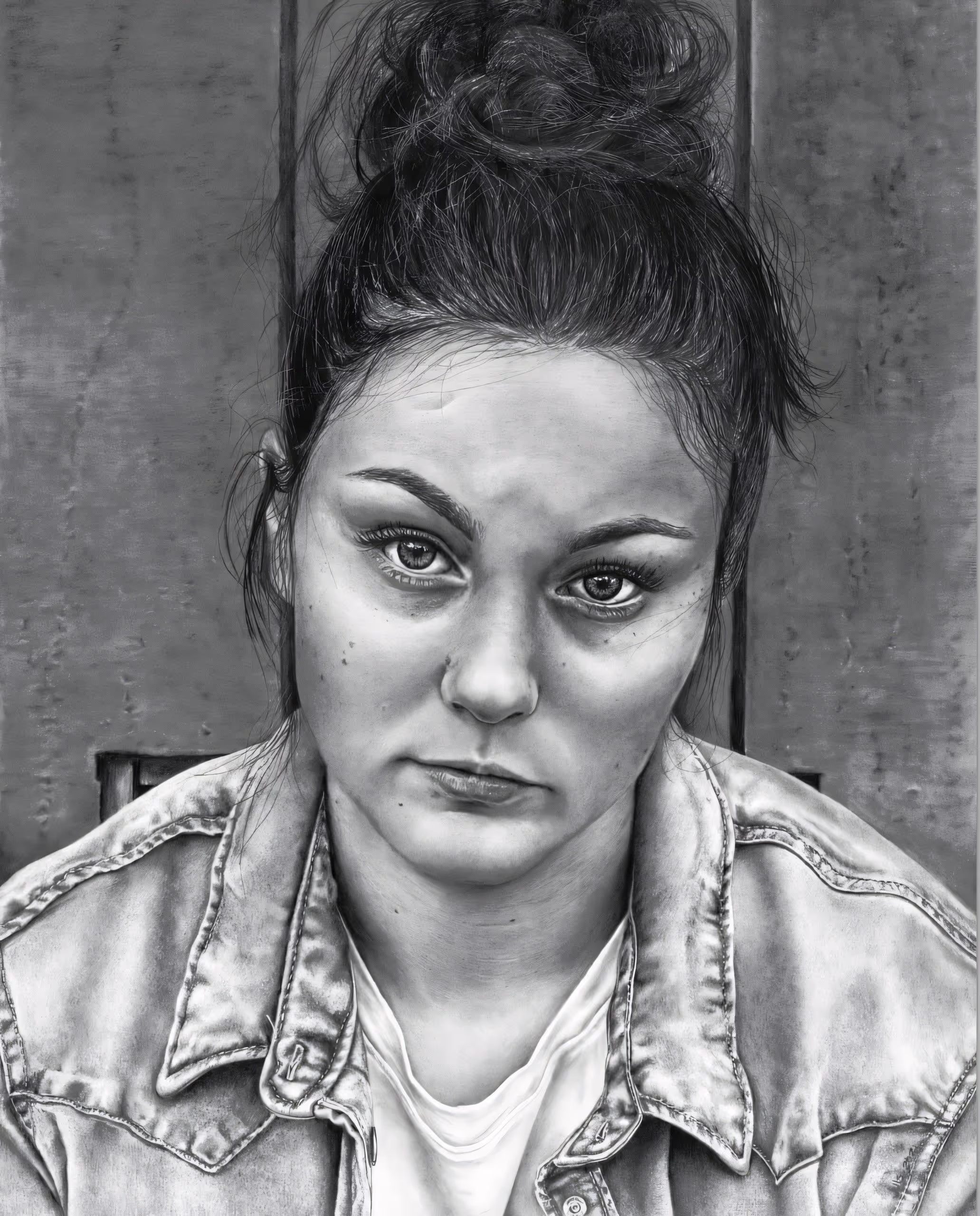
Story
When I was in grade school and high school, I did a lot of art. I like to think it offered me an incredible foundation for what would come much later. In high school, I studied under Walt Bartman, doing oil painting primarily. I was accepted into the Maryland College of Art and Design on a figure drawing scholarship program that they offered to high school students when I was 16. After high school, I went on to pursue my other passion — helping people. I’ve spent the last 25 years working as a psychotherapist. Sometime in the middle of all of that, I had kids (twins), and eventually came back to drawing in 2017. What I do now is primarily self-taught, though I do feel my training and education as a child have created an invaluable foundation for my work today. I’ve watched countless hours of slowed-down YouTube videos and tutorials, and have spent thousands of hours drawing, practicing, and improving. It’s been a wonderful and challenging journey, and I’ve loved every minute of it! My goal moving forward is to continue to learn and challenge myself as I transition to art full-time. I feel the next step is to get my name out there to the art world. I have just recently started applying to calls via café, and have been accepted into a small handful of international juried shows. My goal as an artist is the same as my goal as a human — connection. I work to find the place where we all meet; that place where our differences recede, and we can settle in. That’s why I draw, to find that snapshot moment where someone can look at my art and go, Oh, yes. I know that feeling.
My artistic practice centers on portraiture—on drawing out the unseen essence of a subject and translating it through the delicate control of graphite. I explore the quiet power of detail—each mark is an invitation to slow down, to look closer, and to witness what is often overlooked. Every drawing is a form of deep listening, an act of attention that honors the emotional and psychological presence of the individual.
I believe hyperrealism, when pursued with discipline and sensitivity, becomes more than a replication of the visible world—it becomes a mirror, a bridge, and sometimes, a wound made visible. I’m fascinated by the complexity of the human face and the subtle interplay of light, texture, and expression that gives a portrait its emotional charge. As a psychotherapist, I’m naturally attuned to nuance, which shapes my artistic philosophy: that realism can reveal as much about the internal world as the external one. It allows me to build tonal depth slowly, almost sculpturally, honoring the patience, presence, and attention each subject deserves.
My style has evolved over the last eight years to a refined form of realism that balances technical control with expressive intent. I see art as a language, and my goal is to create a sense of atmosphere and feeling. I’m currently exploring new directions, including the integration of charcoal for its expressive depth and contrast.
My goal as an artist is the same as my goal as a human — connection. I work to find the place where we all meet; that place where our differences recede, and we can settle in. That’s why I draw, to find that snapshot moment where someone can look at my art and go, Oh, yes. I know that feeling.
My artistic practice centers on portraiture—on drawing out the unseen essence of a subject and translating it through the delicate control of graphite. I explore the quiet power of detail—each mark is an invitation to slow down, to look closer, and to witness what is often overlooked. Every drawing is a form of deep listening, an act of attention that honors the emotional and psychological presence of the individual.
I believe hyperrealism, when pursued with discipline and sensitivity, becomes more than a replication of the visible world—it becomes a mirror, a bridge, and sometimes, a wound made visible. I’m fascinated by the complexity of the human face and the subtle interplay of light, texture, and expression that gives a portrait its emotional charge. As a psychotherapist, I’m naturally attuned to nuance, which shapes my artistic philosophy: that realism can reveal as much about the internal world as the external one. It allows me to build tonal depth slowly, almost sculpturally, honoring the patience, presence, and attention each subject deserves.
My style has evolved over the last eight years to a refined form of realism that balances technical control with expressive intent. I see art as a language, and my goal is to create a sense of atmosphere and feeling. I’m currently exploring new directions, including the integration of charcoal for its expressive depth and contrast. I’ve just completed my largest piece to date—a graphite portrait measuring three feet tall and two feet wide—which has expanded both my physical and emotional engagement with the medium, allowing space for story, intimacy, and connection.
My goal is to create drawings that don’t simply replicate life but evoke it—quietly, powerfully, and with honesty.