

Community
Patricia Plumeri left England in 1976 looking to pursue opportunities that were not available in her home country at that time. She worked in Accounting and Corporate positions that allowed her to climb the corporate ladder until 1993 when she opened up her own company that specialized in corporate and small business operations. After 20 years of tending to her clients. It was time to retire and look for a different path.
That path led to the exploration of glass. Its properties and the multitude of actions that are needed to create one-of-a-kind pieces of art that can be created, be it by form or function, the possibilities are endless. From conception to color choices and design, the process of bringing a piece of glass to completion includes cutting, shaping, fusing, and cold working to enhance the beauty of the glass.
Originally from England, and before emigrating to America Patricia was fortunate to travel to many parts of the world, this desire to travel did not stop after coming to America, but opened up even more experiences to observe this world we live in and the diversity of this beautiful planet.
Running my own business required hard work and attention to detail. Artistic creativity was not prized. After retirement the shackles were thrown off, allowing me to let loose the creativity within me that had been stifled for so many years. The process of how to combine glass together to fuse into beautiful objects appears to be never-ending. The blending and fusing of creative thought and physical activity bring about form and beauty to my art pieces.
My inspiration for a glass design comes from what I observe in my daily life. Often, seeing something of beauty will trigger a desire to capture the feeling in the glass. It can involve color, design, or a relationship of images. For example, flying in an airplane over cities I was struck by the similarity of design to printed circuit boards, and sought to capture the idea in my next glass design. Ideas come from everywhere in life!
As a tactile person, the pursuit of handling and making glass art satisfies all of my senses. From conception to color choices and design, the process of bringing a piece of glass to completion includes cutting, shaping, fusing, and cold working to enhance the beauty of the glass.
“Community” This glass sculpture is a representation of the complexity of our community. Every piece is touched and affects the others. Whatever one piece does, all others are made stronger by the connection and enhances our co-operation and togetherness.

Compassion Brings Hope
In these fast-changing times, Ms. Zibit is inspired to create marble sculptures that speak of the enduring beauty of ancient, classic works. Over the four decades Ms. Zibit has carved, she has been influenced by a wide variety of sculptors – each enriching her vision and vocabulary. She learned from master carvers in the workshops of Tuscany Italy, she argued about aesthetics while living with the minimalists in Soho NYC, she spent time deepening and synthesizing her vision living on the rural coast of Maine, and most recently sharing ideas and techniques with carvers in Vermont.
A professor commented on one of Ms. Zibit’s exhibits, “She has discovered in stone the enslaved potential of its color, design, and texture. The versatility of the stone’s tactile potential has been exploited in the surfaces, polished and textured. Carving stone is a slow, patient, and difficult labor. Today one is tempted to seek easier, quicker, more malleable materials and techniques. However, the love of the sculptor for stone has been long and ardent. Melanie Zibit possesses this atavistic love for stone.”
Ms. Zibit’s award-winning pieces are in the collections and have been displayed in private homes, museums, and universities and have been included in publications, such as 100 Artists of New England E. Ashley Rooney (Schiffer January 2011) and Vermont’s Carving Studio Carving out a Dream B. Amore (Kokoro Press, 2008) She has received commissions including honoring the Centennial for the Public Library Middleborough MA and Settlers Green Market Place in North Conway New Hampshire.
For me, creating a sculpture is sharing something deeply personal from one human being to another. I grew up around art. My mother was an avid art collector. I remember accompanying her to the Museum of Fine Arts in Boston as a 12-year-old and visits to the galleries where she would introduce me to renowned experts. Although my high school didn’t have an art program I was selected for weekly classes at the Museum of Fine Arts based on a small sculpture I constructed that sat in the principal’s office. At college, I was captivated when I watched a carver working on a piece of limestone. It inspired me and I soon took a chisel to a small piece of limestone. I immediately knew that carving was my artistic home. Being in tune with the stone – its color, its grain, its size – is necessary to create forms in harmony. There are two pieces submitted for this exhibit: one is made of alabaster, and the other is pink Portuguese marble. Both are elegant materials. The stone allows expression from the most delicate to the monumental, highly polished to natural texture, allowing light to penetrate and emanate from its surface. I enjoy shaping such hard materials into sensuous, flowing forms that suggest the human spirit. When I leave elements unfinished or the natural stone, the viewer is invited to complete the sculpture in their mind’s eye.
The pink Portuguese marble piece “Compassion Brings Hope” speaks of a better tomorrow.

Complicated
Kim Rosebud, a Brooklyn-based artist, seamlessly melds psychology and artistic expression to create works that probe the intricacies of human emotions and the interplay between reality and imagination. Her innovative approach extends beyond traditional mediums, as seen in her solo exhibition “Expressions of Soul”, which incorporated groundbreaking augmented reality projections.
Kim’s versatile artistry is further showcased in prestigious group exhibitions like the ” La MaMa Galleria Family Show” and the “105th Annual Juried Exhibition at the Greenwich Art Society”. She also enchants audiences through vibrant live painting performances, forging deep emotional connections at various live music events.
Lately, Kim has been transforming her art into fashion, designing clothing and accessories based on her paintings. With a growing following, she continues to redefine artistic boundaries, captivating audiences with her immersive creations that seamlessly blend art and fashion.
Color, movement, and the release of emotions. My paintings reflect how I understand life to be. It’s all about adapting and figuring things out as you go along. I start each painting with no plan in mind. Using acrylic, I try out any color combination that comes to mind and paint it abstractly. The colors I choose depend on my mood and I listen to music to intensify that mood. My ideas feel never-ending, I love that there are an infinite number of possibilities available to me and nothing is stopping me from trying all of them out. My art conveys freedom of expression and inspires others to let their creativity run wild.
Composition
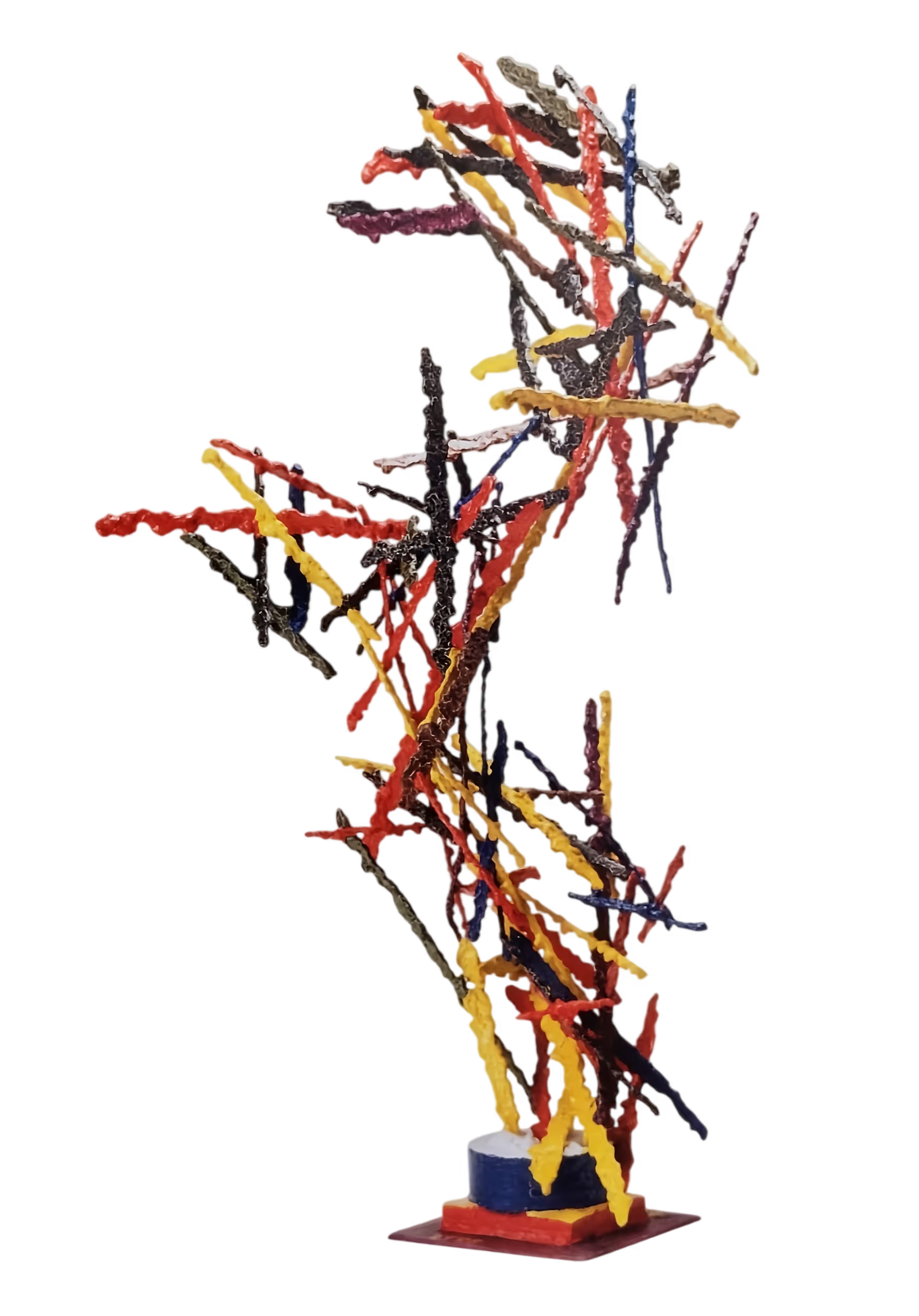
Jason Shih was born in 1972 in Taiwan. In 1991, he began to specialize in metal sculpture when he was a sophomore in the Fine Arts Dept of Taipei National University of the Arts. In 2001, he graduated from the School for American Crafts, Rochester Institute of Technology, USA, and majored in Metal Sculpture. Then, he served as the metal sculptor Albert Paley’s assistant, involved in crafts and public artwork practices. Furthermore, he earned his Ph.D. in Art from the China Academy of Art, China (2015). Now, he lives in Taiwan and consistently engages in both areas of sculpture and public art.
Jason Shih’s artistic vision is shaped by a diverse array of influences, from contemporary dance to avant-garde fashion. He cites German choreographer Pina Bausch and British designer Alexander McQueen as significant inspirations. Bausch’s explorations of time and space resonate with Shih’s interest in sculpture’s capacity to embody kinetic energy and spatial imagination. McQueen’s innovative approach to contemporary imagery and themes provides Shih with a broad canvas for creative expression.
Shih’s work is also influenced by the aesthetic principles of Futurism and Constructivism, movements that emphasize dynamic energy and continuous motion. These influences are evident in his pursuit of capturing the beauty of movement and the elegant restraint of natural forces. Shih’s sculptures often depict moments of defying gravity, capturing the fleeting beauty of motion in a static form.
As a professional sculptor, Jason likes to experience the taste of life with perceptual observation in the subtle moments, and also likes the ever-changing situation of game shapes in the poetic imaginary space. For Jason, art creation is to share various moods and stories in daily life.
Sculpture is to interpret the beauty of light and shadow, rhythm, and volume through the visual techniques of color, shape, and texture. The qualities that the creators of sculpture pursue to touch people’s hearts are actually as abstract as temperature and smell, but rich in profound, penetrating power. This aura that directly points to people’s hearts and the aesthetic sense that makes people enter the drama in resonance may also be like nostalgia, embodied in the nostalgia of seeing things and thinking about them, and the timid expectation of being close to the hometown.
Sea breezes, mountain mist, morning sun, sunset, and, in addition to shape and color, there is also the memory of temperature. Cooking smoke, hot soup, wooden tables, pottery cups, and the echo of the smell are the gradual tone of nostalgia. In people’s daily aesthetic experience, the memory of temperature and smell accompanied by touch often becomes a kind of fuse to revisit the journey of old dreams. The work involved in sculpture creation is to “condense” and record all kinds of beautiful presence in this beautiful time and space in an appropriate way and with true emotions.
As a professional sculptor, Jason likes to experience the taste of life with perceptual observation in the subtle moments, and also likes the ever-changing situation of game shapes in the poetic imaginary space. For Jason, art creation is to share various moods and stories in daily life.

Composition No. 2
Kevin Baldwin (Natick, MA) is an international artist, composer, and saxophonist with extensive training in modern musical techniques. Since completing his Doctorate in Music Composition, Kevin has received residencies and commissions worldwide, including at Akademie Schloss Solitude in Stuttgart, GE. Kevin is renowned for championing the saxophone in contemporary solo and chamber ensembles, called “…precise and energetic…” by the New York Times.
Kevin’s musical compositions utilize experimental instrumental techniques and noise timbres, asking performers to alter their mindsets of the traditional performance paradigm. Coinciding with these experiments, Kevin works heavily with notation and the visual aesthetics of his scores, utilizing semiology to change the performer’s relationship to the sounds. These trials in notation led to the impetus of his visual art: using visual musical elements, sounds, and structures.
The score of a musical work is fascinating. As a composer, I spend hundreds of hours alone with a score to unearth and present the uniqueness of every sound. I consider the physicality of a sound, both in the depth of overtones and frequencies and in the most minuscule human motions it takes to produce them. I consider texture, the harsh and grinding color of the cellist utilizing overpressured bowing, and the intimate fragility of the flutist’s unstable multiphonic. I consider the shape, from violent rhythmic gestures to light, lyrical flurries. I consider form, how various larger blocks made up of colors, textures, layers, and rhythms work together to highlight every unique aspect of a sound. I consider the weight of each and every observation I make, and I ensure every mark in the score best reveals the essence of a sound. Through my paintings and drawings, I open the traditional definitions to create visual music.

Concorde Du Rouge Et Bleu
SMYLIE was born on March 3, 1948, on, what his mother told me was the worst blizzard the city of Calgary Alberta had ever witnessed. Norma took it as an omen. One of his first memories, he tells me, was crawling to a mirror propped against the kitchen cupboards. He remembers looking behind and seeing a canvas stretcher.
SMYLIE is practically illiterate which is why he makes things that were once called “art”. He foolishly believes that the “art” will speak for itself.
Cone Flower
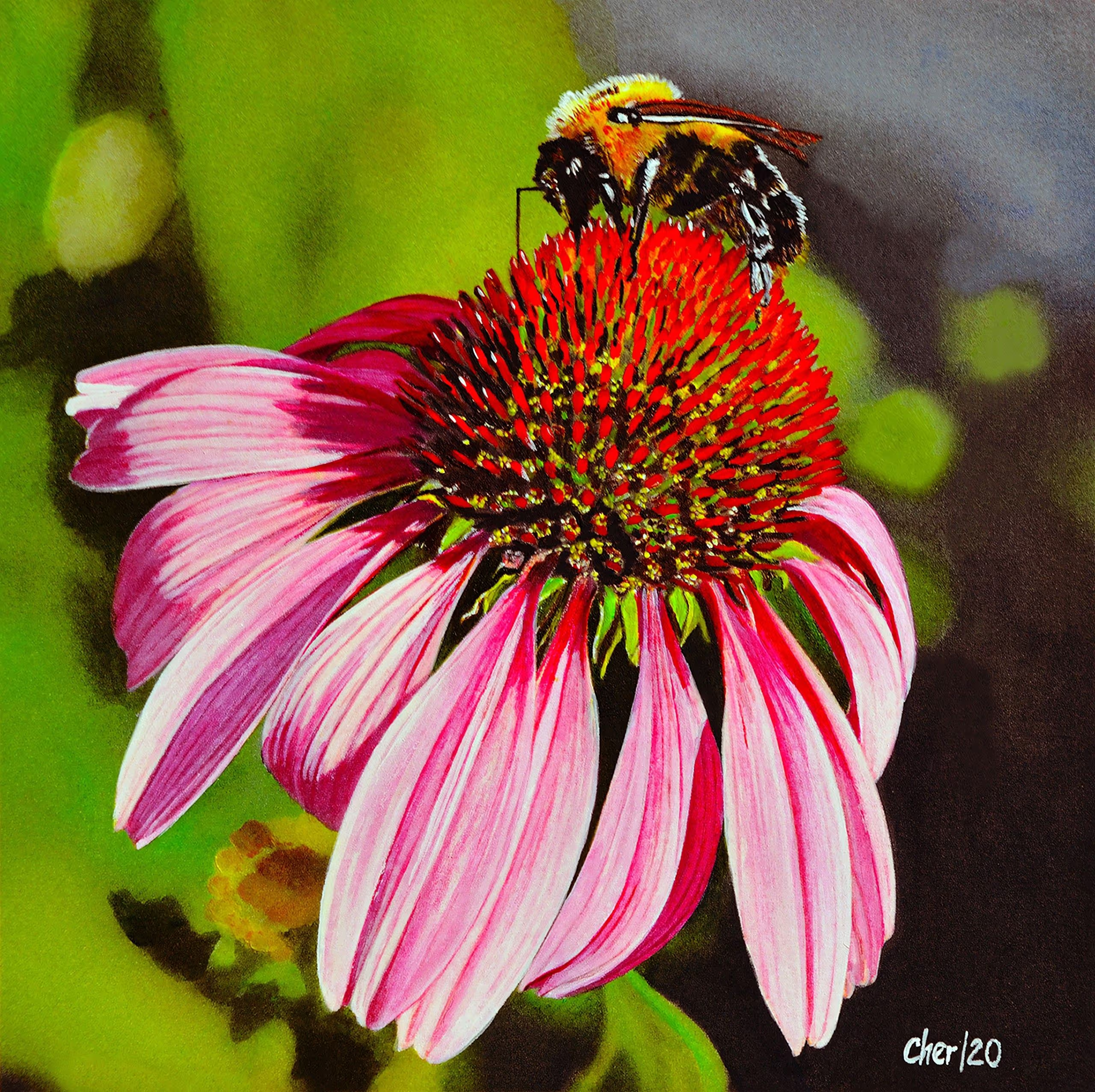
Cher Pruys was born in Regina. Over the years, she lived in many places, including Saskatoon, Calgary, Edmonton, Ottawa, Fort Frances, settling into her present home in Devlin, on the banks of the Rainy River with her husband Mark and pets.
By age three, Cher was seldom found without a drawing tool in hand. She worked in pencil, charcoal, and ink over the years, picking up a paintbrush at the age of 35. Beginning with oil paints, she found her chosen mediums in acrylic, watercolor, and gouache, and her passion for hyperrealism.
Although self-taught, her dedication and talent have seen her work juried into 1017 International exhibits. She has won 1547 awards for her work in the International Juried Exhibits.
Her work has graced the covers of 3 books, 45 magazines, including The Best Of Acrylic Fall 2021, cover of the May 2022 Arabella Magazine, #20 Hyperrealism Magazine with “Girls Girls Girls”, & #21 with “The Young Cowboy”, Artists & Illustrators March 2024 Artistonish 2024 July edition, Observica Elite 2024, Art Closeup Magazine#26 Jan. 2025, The back cover of Novum Artis #007, 2025, Hyperrealism Special Edition “The Amazing World of Cher Pruys” , The Cover of Sfumato 2026 Fall Reawakening Group Show Magazine, & The cover of Louvre Unbound Volume 5. She has been featured in over 1000 International publications. Cher’s works have found a permanent home in private and public collections worldwide.
“To take my inner visions with my hands and create a work of art for you, the viewer …. That is the ultimate in self-expression.”
Every day moments really capture my attention. Ones that trigger memories or evoke a strong emotional reaction on my part quickly become my next obsession. By observing these often-fleeting moments, I notice that my views on life, especially in terms of time and how little of it we as individuals each have, and how one’s own perspective overall can be narrow, thus I use them to spur growth in myself with a desire to enhance the human experience.
I truly feel that my artworks are the most rewarding and fulfilling way for me to communicate my inner thoughts and feelings with those around me.

Congregation
Mr. Diephouse is a primarily self-taught photographer who migrated from film to digital photography about fifteen years ago. After retiring from a professional management career, he has more actively explored the technical and creative sides of this media. He has exhibited widely and has earned recognition in local, regional, and national exhibitions. His photographs are also included in several corporate and private collections.
I am attracted to a wide variety of subjects ranging from natural landscapes, botanicals, and wildlife to images that provide either abstract expression or social commentary. I am interested in sharing images that evoke a story of some kind. Images may be simply documentary, reflect a sense of time and place, or resonate on a more abstract level of color, shape, or form. Others provoke an indefinable question that does not readily yield answers without further study and reflection.
Most often I am drawn back to images created while wandering through the back roads and small towns of the upper Midwest. These images of architecture, commerce, and social life often reflect a mixture of nostalgia and a changing set of forces that shape life in the heartlands. Most recently I have begun exploring digital collages as a means of expression.

Connected
Manuela Eibensteiner – born 1968 in Austria. She lives and works in Freistadt (Upper Austria) atelier ART-ME.
Her great passion, painting, began at a young age. The fascination of the colors, and their expressiveness captivated her, in addition to the activity as a tourism specialist, a steadily growing artistic curiosity developed. Dealing with a wide variety of materials, playing with color and light impressions with glaze technique in representational, impressionistic, and sometimes fantastic representation. Encounters with trees, stones, and people influence the painterly processing of these impressions.
The urge for more knowledge led her to numerous courses and art studies, with artist friends, where she was able to acquire a wide variety of techniques: from the “old craft” of reverse glass painting, and hollow glass painting to working with oil, acrylic, and charcoal on a wide variety of surfaces (paper, wood, cardboard, canvas, fabric, leather …) She thinks about how to capture nature in pictures. Surrounded by the beautiful Mühlviertel, she draws strength and inspiration from nature and love for their family and friends. Here in Freistadt she works in her studio and looks forward to numerous visitors from home and abroad.
Manuela Eibensteiner’s artistic journey is a testament to the power of creativity, authenticity and perseverance. Her ability to unite the energies of nature and imagination, coupled with her unwavering commitment to her craft, has helped her gain international recognition. As an artist who dreams of connecting people through her art and leaving a lasting legacy of unity and joy, Manuela’s journey is an inspiration to anyone who wants to make a name for themselves in the world of art.