
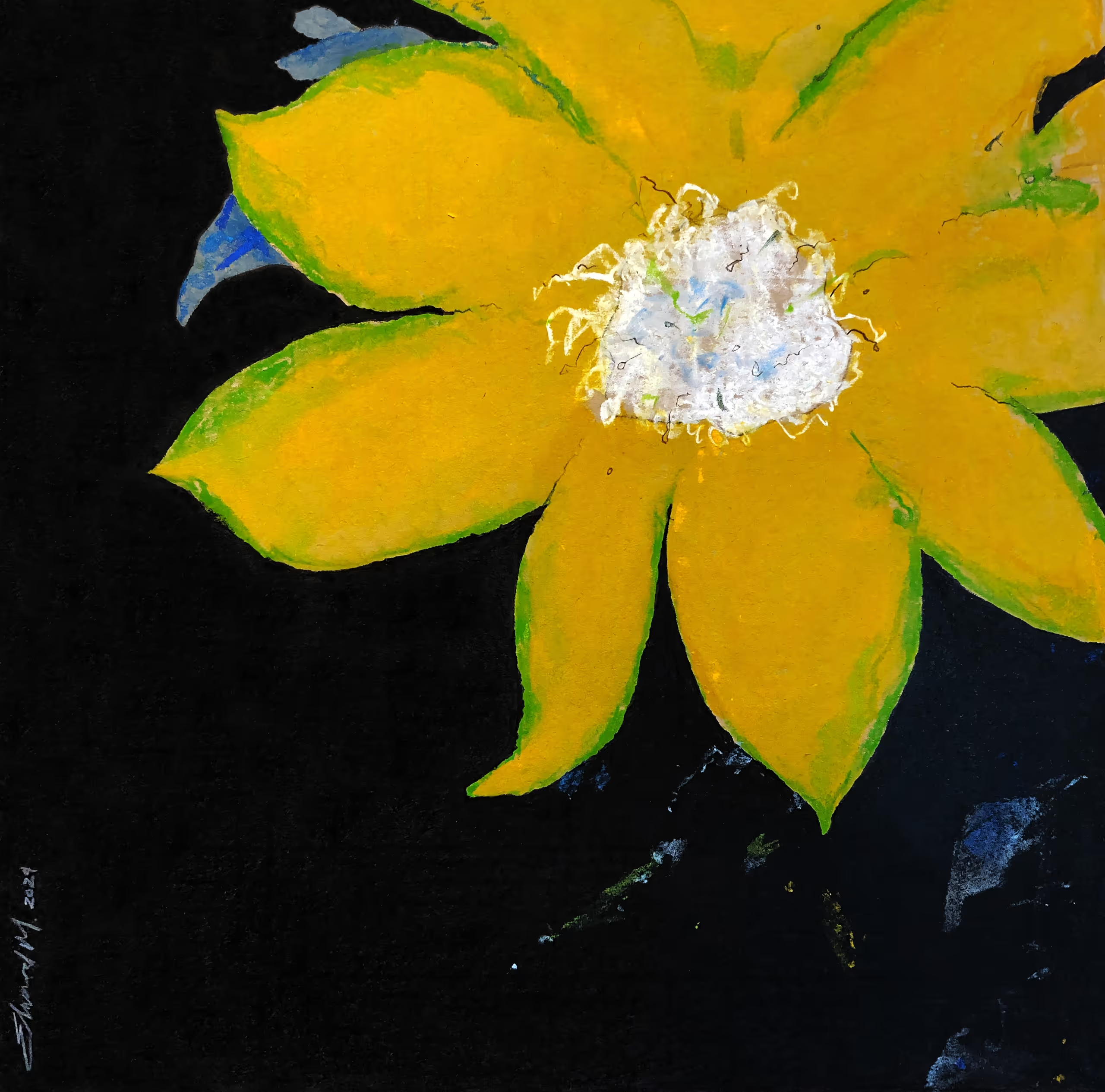
Altered Bloom Yellow
From childhood joy and interest to adult determination and training, my journey is not so different from so many other artists. Much credit must go to my parents for indulging my interest and not standing as a barrier to my development. Quite to the contrary, I was given rich opportunities and a fair share of luck growing up. Luck came by way of wonderful art teachers in school and Saturday classes at the Detroit Institute of Arts. There is a sidebar story in all this that has to do with my poor health as a child and how it prevented me from taking part in athletic classes. That disappointment provided opportunities for more art training and exploration. My circle of friends consisted of musicians, actors, dancers, writers, and, of course, visual artists. As a result, my childhood orientation was entirely cultural starting in the 1950s and 1960s.
Post high school, I was accepted to The Art School of the Society of Arts & Crafts in Detroit. I did well, winning a merit scholarship for my work blending graphic design with fashion illustration.
I moved to Toronto, Canada, after art school to apply my skills to things other than automotive-related advertising, the focus in Detroit, and that was such an exciting place for any young artist to work in the 1970s. I did graphic design and illustration for fashion, package goods, and government services like the Ministry of Natural Resources.
Now well into the second chapter of my life, and living in Michigan, I’m finally doing what my heart always wanted: fine arts. It’s not that I didn’t like my life as an applied artist; it’s that I also needed to answer a very different calling in the arts.
I am an artist working in 2D and with traditional tools and materials. I am not a message artist and resist any kind of description beyond the most basic observations and influences of my work product. My goal is to create a visceral and thoughtful experience that invites the viewer into my world rather than leaving them as an outside witness.
Life in all its colors, textures, patterns, and voices held together by the tread of our shared humanity…tenuously, delicately, hoping to travel with just one caring soul. My visual images seek to create sounds from the colors and stories yet to be completed in our imagination from the shapes and formations.
To see without assumptions is perhaps one of the greatest challenges I have faced as an artist. To look deeply, with all my senses, into the abyss and discover rather than define, and allow experiences to wash over me. I don’t plan so much as absorb what notion is presented and let the spirit guide me. This is not science. It is not predictable or rarely repeatable, and is art meant to illuminate and provoke. I don’t believe in style selected or applied artificially, but as more of an unconscious personal signature of how an artist speaks. Style should never be confined by subject or materials, but rather part of a conversation the artist is having and sharing.
My artistic goal reflects a seeking and a desire to find those visual voices that do not always harmonize but, in their distinctive expression, create the texture of one’s life.

Amanda
Born in North Dakota, Mark Kaufman came of age during the 1960s. A champion for gender equality, Mark paints the female figure in sometimes absurd, sometimes haunting locations. Far from creating emotionless family portraits, Mark blends color and imagery to explore themes of mythology, literature, philosophy, and emotion.
He studied at the Pennsylvania Academy of Fine Arts. Mark’s work has been shown in Galleries across the nation. He is a signature member of the Baltimore, Delaware, Pennsylvania, and Philadelphia watercolor societies. He chooses watercolor as a medium because it is fluid and sometimes serendipitous.
Thirty years ago, Mark was diagnosed with Bipolar Disorder. In addition to painting, he is highly visible in the community providing support and advocacy for all those who suffer from mental illness. The bipolar helps shape his work, more in some collections than in others.
I came of age during the 1960s. As a lawyer and citizen, I was and am a champion for gender equality. I paint the female figure in sometimes absurd, sometimes haunting locations. Far from creating emotionless family portraits, I blend color and imagery to explore themes of mythology, literature, philosophy, and emotion. Here and there I will do floral or landscapes and faces too.
I studied at the Pennsylvania Academy of Fine Arts. My work has been shown in Galleries across the nation. I am a signature member of the Baltimore, Delaware, Pennsylvania, and Philadelphia watercolor societies. I chose watercolor as a medium because it is fluid and sometimes serendipitous. I also do woodcut prints and carvings in wood.
Thirty years ago, I was diagnosed with Bipolar Disorder. In addition to painting, I am highly visible in the community providing support and advocacy for all those who suffer from mental illness. The bipolar helps shape my work, more in some collections than in others.

Amber Meadow 3
Aleksandra was born in 1987 in Poland. She is a graduate of the University of Warsaw. She loved to paint since she was a child. For many years she participated in classes conducted by prof Paweł Lewandowski- Palle. She loves the diversity of the world and it is from this diversity that she draws inspiration. Aleksandra took part in many exhibitions around the world. Her paintings have been in, among others, New York, Rome, Venice, Barcelona, Munich, Sanremo, Valetta, and Paris. She received many international awards, e.g. Woman Art Award 2022 in Paris, ATIM’s Top 60 Masters in New York, Career Art Award in Sanremo, etc. Her paintings have also appeared in many publications.
I love the diversity of the world and it is from this diversity that I draw inspiration. For me, art is one of the forms of communicating with people, communicating without words. Image is a universal language for me. In my paintings, I want to show the beauty that surrounds us and to which we often do not pay attention: the beauty of nature, the beauty of dreams, the beauty of gestures, traditions, and people. If you just look deeper, you can see that the world and life are beautiful.

American Jukebox
Bobby is an “end-to-end” digital artist who does all the work himself. He is equipped with specialized skills in image/video processing, digital generative and derivatives arts, etc., using diversified methods, multiple software, and techniques to derive his creatives.
In terms of style and themes, Bobby likes colorful stuff. Although some of his works may carry similar themes, he believes “while imagination has no border, art has no limit”, and that includes the techniques used in turning imagination into realization, and injecting digital science into the presentation process of the creatives.
Bobby believes that most artworks existed due to the intention of the artist to “communicate” his/her feelings to others, be it on an aesthetic piece of work, a sculpture, an illusion, a game, etc. In recent years, the rapid advancements in digital science may have added more venues and techniques for an artist to “communicate” his/her feeling, which may otherwise be lacking in traditional arts. These advanced techniques could include using AR, multimedia, website, metaverse, etc., This application of digital science on traditional arts created a hybrid known as “Digital Arts”, which is understood by many as “artistic work or practice that uses digital technology as part of the creative or presentation process”. However, in Bobby’s opinion, whereas digital technology is used in the creative process, it is currently underutilized in its use in the presentation.
Bobby further believes the introduction of digital science into arts would eventually bring about a paradigm switch as to how arts would be appreciated in the future. For example, expression may no longer need to be confined to the creative itself as additional elements of surprise, participation, interaction, engagement, etc., may now be “extended” outside the realm of the original creation with the help of technology onto other “digital devices” such as mobile phones.
In the creative preparation process, I favor more vibrant colors over dull ones, and more derivative and generative arts over (digital) painting and brushes. Both derivative and generative arts called for high-level digital processing techniques, and reproductions of digital elements using similar image processing and presentation software such as Adobe, PowerPoint, and beyond.
Statement on American Jukebox
Never mind the fact that this American antique is seldom seen nowadays, this artwork is a “Love and Hate” relationship. Some art lovers think it is more science than art and thus hated it. On the other hand, those nonconventional ones love it, as it is a true “digital art”, where science is applied to visual arts.
Notes on Dimensions and Size for Digital Artworks
Digital Arts could not really be measured by dimension and size but by pixels as good resolutions images could fit something as small as a phone but as big as a TV set. The artwork presented here has a resolution of 1920 x 1080 pixels, which is equivalent to industry-standard Full HD 1080p. This is equivalent to roughly 20 inches (50.8 cm) x 11.25 inches (28.6 cm) in dimension and size, based on a rather useless scientific conversion.

American Victorian Restoration
Second place for oil painting Southern Allegheny Museum of Art purchased for their permanent collection
First Place for oil painting, Southern Allegheny Museum of Art Loretto PA
The permanent collection at State Museum (Harrisburg, PA)
First Place Art of The State 2007, Pennsylvania State Museum, Harrisburg, PA
Third place Art of the State 2008
2nd place Art of the State 2009
First place in 2015 – 48th annual Art of the State for painting (The State Museum of Pennsylvania)
The 32nd Chelsea International Fine Art Show(won a show at the Agora Gallery NY,NY) August 19th to 30th, 2017
Excepted into the LAS LAGUNA Gallery /2023 Figures and Faces show /Laguna Beach/California
Allen Capriotti is an American realist with a modern vision. His paintings are well within the tradition of American realism as defined by artists such as Thomas Eakins and Rembrandt Peale. Capriotti looks at America – its people, landscapes, and architecture – and describes the beauty he finds in everyday life. His paintings celebrate the underlying nature of the people he meets and their significance in shaping the world around them. Capriotti sees the importance of the smallest details in the overall picture and fills his work with the honest nature of people.
Capriotti learned his traditional use of painting materials and technique from his twenty years as a paintings conservator for Albert Michaels Conservation, Harrisburg – Pennsylvania, and Evergreen Painting Studios, New York – New York. He learned the importance of properly preparing a painting from the support to the subsequent sizing, ground, grisaille, under-painting, and many layers of thin color glazes.
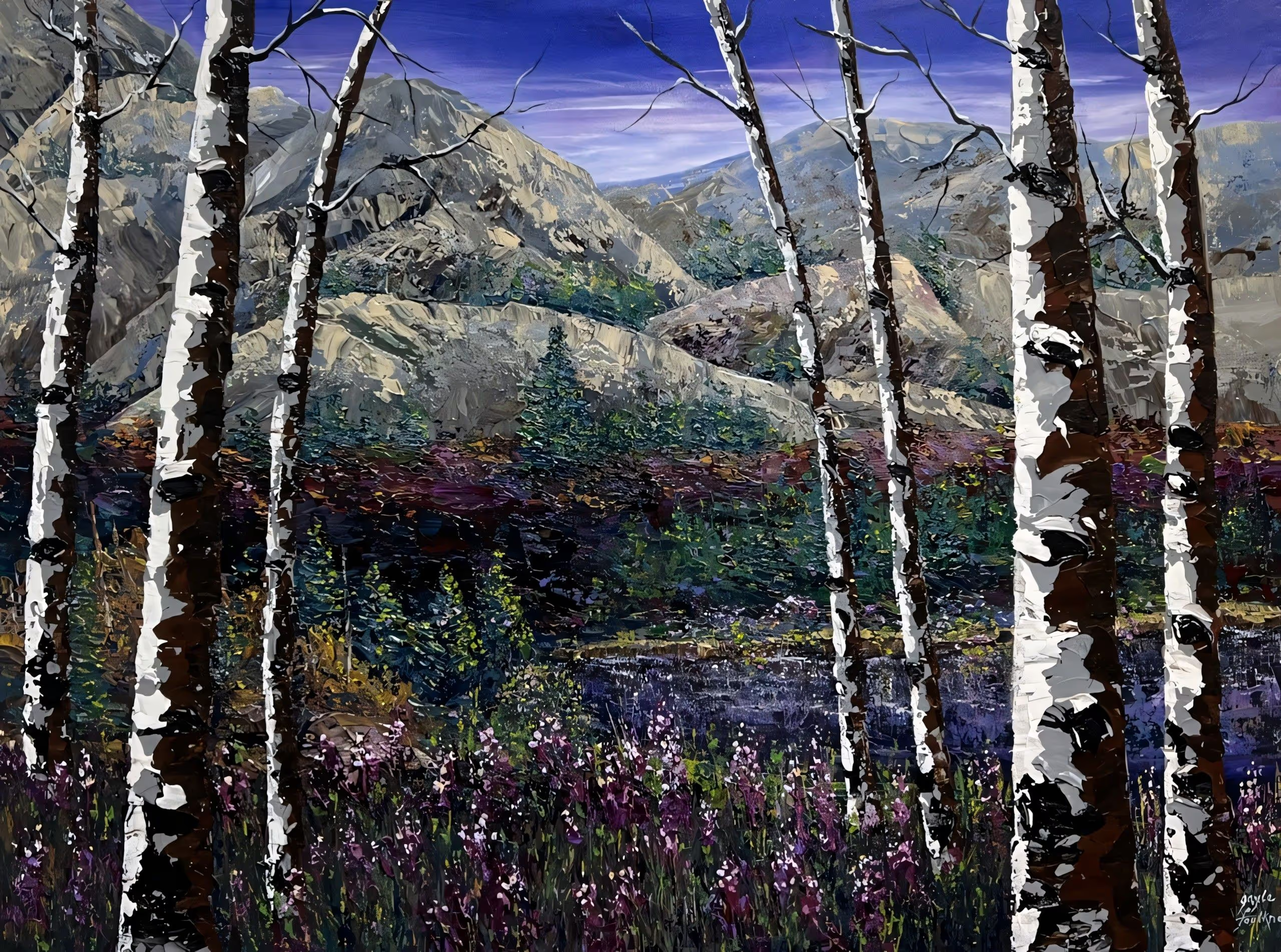
Amethyst Beauty
Gayle Faulkner, with over 35 years of artistic exploration and creativity, stands as a seasoned watercolor, acrylic, and mural artist. Her journey has been marked by constant exploration, a playful engagement with diverse media, and an unwavering commitment to growth in the world of art.
Her academic journey, rooted in a BA in Sociology from William Jewell College in Liberty, Missouri, initially led her to work with children, integrating art into their day-to-day experiences. Gayle’s passion for art eventually pulled her into a more immersive pursuit. She delved into Art and Design courses at Louisiana Tech University in Ruston, unlocking her artistic soul. The willingness to ”put herself out there”, coupled with years of hard work and a penchant for thinking outside the box, allowed her to undergo a major growth period.
Finally, the challenges posed by the COVID-19 quarantine became a catalyst for Gayle’s artistic metamorphosis, leading her to focus on acrylic paintings on canvas. Engaging in an online course.
In my art practice, I describe my creations as Textural Acrylics. This term represents the exciting experience of observing paint flow from the palette knife, forming captivating textures and colors. Each stroke channels emotion, and every canvas captures a moment of creative inspiration.
My process is spontaneous – I start with a loose outline, sketch the composition, and then fully immerse myself in the act of creating. Throughout the process, music is my closest companion, its volume soaring. I dance to the rhythm, losing myself in the beats, and, on occasion, even letting out a song. My painting process is a multisensory experience, an immersive journey into the fusion of sound and color, where each note becomes a brushstroke, and every stroke on the canvas is a dance of creation. I often liken my paintings to cherished children—it’s a relationship that involves nurturing, engaging in heartfelt conversations, and weathering the challenges of creative adolescence with boundless love and patience.

Amongst The Crowd
I received my BFA and MFA from Rochester Institute of Technology. My thesis was “Kviatkev, the Understanding of Abstraction.” I have been drawing since age 4. My background is a BFA and an MFA in painting with minors in ceramics, design, and printmaking. I began my career from 1976 to 1991 and during the dormant years, from 1991 to 2021 I still painted but did not exhibit. Tumultuous times but healing times. During the isolation of COVID, I began to paint again and found a genuine newness and expression in my work. I follow T. S. Elliot’s Objective Correlative. This is a means of expressing emotion in art by using either a set of objects, a situation, or a chain of events. Through this method, the painting becomes that emotion. My style leans towards abstract painting because it supplies the necessary tools to allow the portrayal of thoughts and emotions in work. In my work, I do not dictate the emotion found in my paintings; but leave it for the viewer’s discovery and interpretation. This work subjective in nature, utilizes color to illustrate feelings, and dreams, and with each piece, there is an underlying core of darkness and a definite area of light. This draws the eye over the piece to the core. The lines keep the eyes moving, while the dots scream, “Look at me”. The work ranges in size from small works on paper to 48×48 inches on canvas. With each piece, there is an underlying core of what could be construed as darkness and a definite area of lightness.” The exchange between colors, lines, and shapes tells my story.
My paintings began to unravel and reveal the silence, the fright, and the tribulations throughout childhood to the end of a destructive marriage. The screams never heard, the tears never seen, the fear not shown, constant fear, the shame of body and mind. My paintings then became the venue for my self-liberation. My art depicts the evolution from childhood terrors to adult recovery and brings light to the darkness. In addition, there is growth in my work, reflecting the joy found in other areas of my life. My art was reclusive and hidden for years. During the isolation of COVID, I began to paint again with zealousness and ease and found a genuine newness and expression to my work that began to sing. I found my voice and soul again in painting. Emergence began and exposure of my art was welcoming.

Amongst The UFOs
Michael Tilbury is a disabled combat veteran who recently graduated from the Maine College of Art & Design with a Master of Fine Art. Making art and writing poetry has been therapeutic and a necessity in his quest to heal from the effects of war. Twice a month he teaches his niece and nephew art lessons so that they may find enjoyment in the act of creating for themselves. He has recently taken a keen interest in blind contour drawing from one of these lessons and plans to pursue it to build his universe.
This body of work focuses on my incessant need to create otherworldly portraits. Self-portraits, aliens, holy people, wise people, and others populate this universe. Growing up religious, I was inundated by iconography and wished to emulate that feeling of righteous importance within my work. Drawing has allowed me to fully let myself create without any self-judgment. I trust in my physical movements to interpret my thoughts and ideas by relinquishing visual acuity. Embellishment with bright colors, metallic leaf, and fabric are then combined to bring life into these blind contour drawings.

Amore
Bobby J. Jones was born and raised in Texas from 1966 to 1989. Jones attended Texas Tech University and graduated from his family’s alma mater with a BFA in Art (Painting and Drawing) in 1989. Bobby moved to Albuquerque, New Mexico, and attended The University of New Mexico. He received his master’s degree in Art Education (Museum Education, Ceramics, and Photography) in 1994. Jones worked in Retail Management in California for 12 years and in Customer Service for 4 years in New Mexico. He currently works for Albuquerque Public Schools. Even though Bobby has lived in Texas, California, and New Mexico, he considers New Mexico home!!!
Bobby is a Lifetime Member of Alpha Phi Omega, Golden Key National Honor Society, and Phi Theta Kappa Honor Society. He was a member of the now-closed Matrix Fine Art Gallery. Jones is also a member of The New Mexico Imaginative Arts Collective and The Art Posse at First Unitarian Church.
He continues to exhibit his artwork at different art galleries in Albuquerque (The Tortuga Gallery, The South Broadway Cultural Center, The Albuquerque Open Space Visitor’s Center, and The Gallery With A Cause at The New Mexico Cancer Center). He also exhibits his art online through international art exhibits through The Biafarin Company in Ontario, Canada. Jones also creates publications of his coloring books, his photography, and his artwork. These publications are available on Amazon and online through Barnes & Noble. Jones has a website through Art Storefronts. Where art lovers can buy prints and artwork from this artist!!!
While in the rehabilitation center, I focused on things that make me happy. These everyday objects included hearts, butterflies, and sunflowers. These images of these special objects reminded me of my mother, the late Mary Katherine Brown Jones, and her wonderful legacy! While working in the classroom with my preschoolers, they would do something special. I would say to them kindly, ” You make my heart smile.” With beautiful butterflies, I would see them fly across a lovely spring meadow. I would say lovingly. ” Thank you for bringing your beauty into this world.” Sunflowers bring joy and happiness into my life these days. Sunflowers seem to smile all the time! These images remind me to be joyful! Why? Cuz I am HAPPY!!!!0