

The World Is Asleep, Except For Dogs, Drunks And Me
Michael Bruner is an artist living and working in rural Illinois, United States. Michael was born and raised in Indiana and received a B.F.A and M.F.A. from Indiana State University, studying under Leroy Lamis, Dick Hay, and Charles Reddington.
“I’m a solitary person. My art is something for which I am fully responsible. It belongs to me. I have always approached my art in that I don’t owe anything to anyone in this one part of my life. I do what I want, how I want to do it. If others view it favorably – outstanding.”
My drawings are sometimes hyperreal and surreal – highly-detailed figures described in pencil with a precision that is sometimes beyond photographic. My works take as subject dreams, memories, and their metaphors, and consider the complexities of identity and subliminal emotions. In composition, my drawings are influenced by images that evoke a momentary recognition in the viewer and a sense of familiarity, but with a confusion of pushed reality, and a combination and exchange of the real and unreal.
My work marks a period of my life and I attempt to show the line of my march and stick to it. My work reflects what is happening to me at the time. I have always approached my art in that I don’t owe anything to anyone in this one part of my life. I do what I want, how I want to do it. If others view it favorably – outstanding.

The Zebra In The Room
Sylvia Bandyke, Royal Oak, MI, USA, is largely a self-taught photographer, having taken studio and art history classes in college. She began her art career by displaying photo collages in ArtPrize, an independent international art competition in Grand Rapids, MI, from 2014 to 2018. Subsequently, she has been juried into more than 100 group exhibitions in 24 states and accepted into numerous online international exhibitions. An awarded artist, she keeps an eye open for interesting views of a subject while looking for hidden beauty every day. Most recently, she was a caregiver to her elderly mother and was able to create some memorable, unique art as a result of this experience.
I prefer using the collage format to integrate associated images into a cohesive unit that is even more compelling because of the embedded story. Having been a playwright and technical writer, I am accustomed to delivering content with a message. So now, as a visual communicator, I continue to provide meaning via the structure of the collage format, wherein the four photos confirm, augment, or even contradict each other if warranted. I enjoy offering the richness that the multiplicity of images provides, along with the impact gained through thoughtful positioning of them. Ultimately, I intend to have my work act as a doorway to the viewer’s own mental and emotional framework regarding the collection of images, perhaps finding their own very personal meaning in them.

Theia
Adrian Hatfield makes work examining the visual language strategies of science, pop culture, and fine art history in conveying unfathomably huge subject matter. Recently, his focus has narrowed to address the overwhelming reality of our unfolding environmental catastrophe.
His works are included in the public collections of The University of Michigan, The South Bend Museum of Art, the Northern Arizona University Art Museum, and The University of Iceland in Reykjavik, Iceland. Solo exhibition venues include Manifest Gallery, Cincinnati, OH, The South Bend Museum of Art, South Bend IN, ARC Gallery, Chicago, IL, and Biggin Gallery, Auburn University. Two-person and small group exhibition venues include The Butcher’s Daughter, New York, NY, Jeffrey Leder Gallery, New York, NY and Jack the Pelican Presents, New York, NY. Publications include The Manifest Press International Painting Annual, Fresh Paint Magazine, Studio Visit Magazine, and Essay’d.
My research is fueled by anxiety about our current environmental crisis, and it reflects an attempt to understand these events through the lens of geologic time while simultaneously criticizing our present-day response to them.
While society is understandably dismayed at the prospects of rising oceans, shrinking agricultural production, increased natural disasters, and mass extinction, it is also true that the processes of life and evolution will continue with or without us. New ecosystems will emerge and new species will thrive. I find this process inspiring and beautiful, as well as a bit comforting in the face of potential disaster. There is hope in the realization that the natural world is bigger than us.
The intention is for the paintings to convey those experiences in tension: dread, splendor, joy, terror, wonder, and the absurdity of human inaction. Their iconography samples and recombines elements from art history, illustration, and satire, with a goal of existing somewhere between a requiem, a science fiction fever dream, and a call to arms.

Themis We Are
Sarah Rieser is a former interior designer who turned her mid-life health crisis into a BFA from the School of the Art Institute of Chicago. She has been exhibiting in fine art galleries since 2012, including a solo show through The Art House. Her pieces have appeared in Werks, Artistonish, Residual Believers, Quaranzine, ArtAscent, and Women United contemporary visual art magazines. In 2024, Sarah’s work is on view at Side Street Studio Arts, Saint Luke’s Lutheran Church of Logan Square, Black House Artist, Agitator Gallery, Oak Park Art League, and Buchanan Center for the Arts.
Building upon the collective skill sets of my suburban upbringing, interior design background, and fine art training, I am investigating the duality of my relationship to the conventionally accepted hierarchy of art and craft which positions women’s work as the lowbrow province of hobby, and I intend my work to reframe a contemporary idea of the inferior homemade as the elevated handmade while simultaneously addressing social issues relevant to my experience as a 21st-century female entity.
Themis, We Are reimagines the Greek Titan, who is the mythological basis for our Lady Justice, as a feminist agitator standing before a protest flag that reads, Support Your Sisters (front) Not Just Your Cisters (back), while peeking out from her blindfold and holding onto breast-weighted scales.

There Is A Crack In Everything…
I am a lifelong drawer and doodler, but only started painting—and naming and keeping what I paint—in 2019. It was a particularly turbulent time in my life, and painting turned out to be a surprisingly effective (and enjoyable) kind of therapy. Just this year I finally summoned the courage to create an online gallery, Quantum Foam Studio–a space to put my work out there for public viewing. If you’re wondering about the name, it is a nod to my fascination with the baffling and endlessly engaging quantum realm. This utterly nonsensical theory, preposterously accurate in its predictive power, tells us a strange, ultimately unknowable fuzziness governs the fundamental nature of reality. The elementary particles are not real, after all; they form a world of potentialities and possibilities rather than one of things or facts. That serves as a kind of impetus for my painting: it is thrilling if any of my work evokes possibilities or potentialities in a viewer.
I am originally from Malden, Massachusetts, the end of the Orange Line, and though I’ve not lived there for nearly forty years, it will always be home. I’ve lived all over the country, from Bloomington, Indiana to Arlington, Virginia to Ann Arbor, Michigan to Tucson, Arizona to Ellicott City, Maryland; the culture and geography of each place have left a different kind of imprint on me. I currently can be found in central New Jersey with my two cats, Aubrey and Maturin. I am the proud father of three grown sons and the newly minted grandfather to the most beautiful baby boy in the history of ever.
Abstract art is the best way I’ve found to get the thoughts, ideas, worries, anxieties, stupid jokes, and whatever happens to be rolling around my skull out of my head and onto something I can see and touch. Think of it as a kind of visual journaling. I struggle with a major depressive disorder and substance use disorder. My paintings are very often animated by the difficult and often unpleasant moods, or mindscapes, that are part and parcel of my mental health issues. Even when the work is not so inwardly focused, when I am inspired by a piece of music or poetry or ruminations on history, what ends up on the canvas (or wood, or whatever) is always filtered through the peculiar workings of my brain and its moods.
I’ve built a portfolio of 150 or so works—some dark, some whimsical, and some, well, I’m still figuring out what they are. They all carry some sort of emotional significance to me. I do not expect them to be meaningful to anyone else but am gratified if any of them stir a bit of wonder, curiosity, or something else entirely in anyone who sees them.
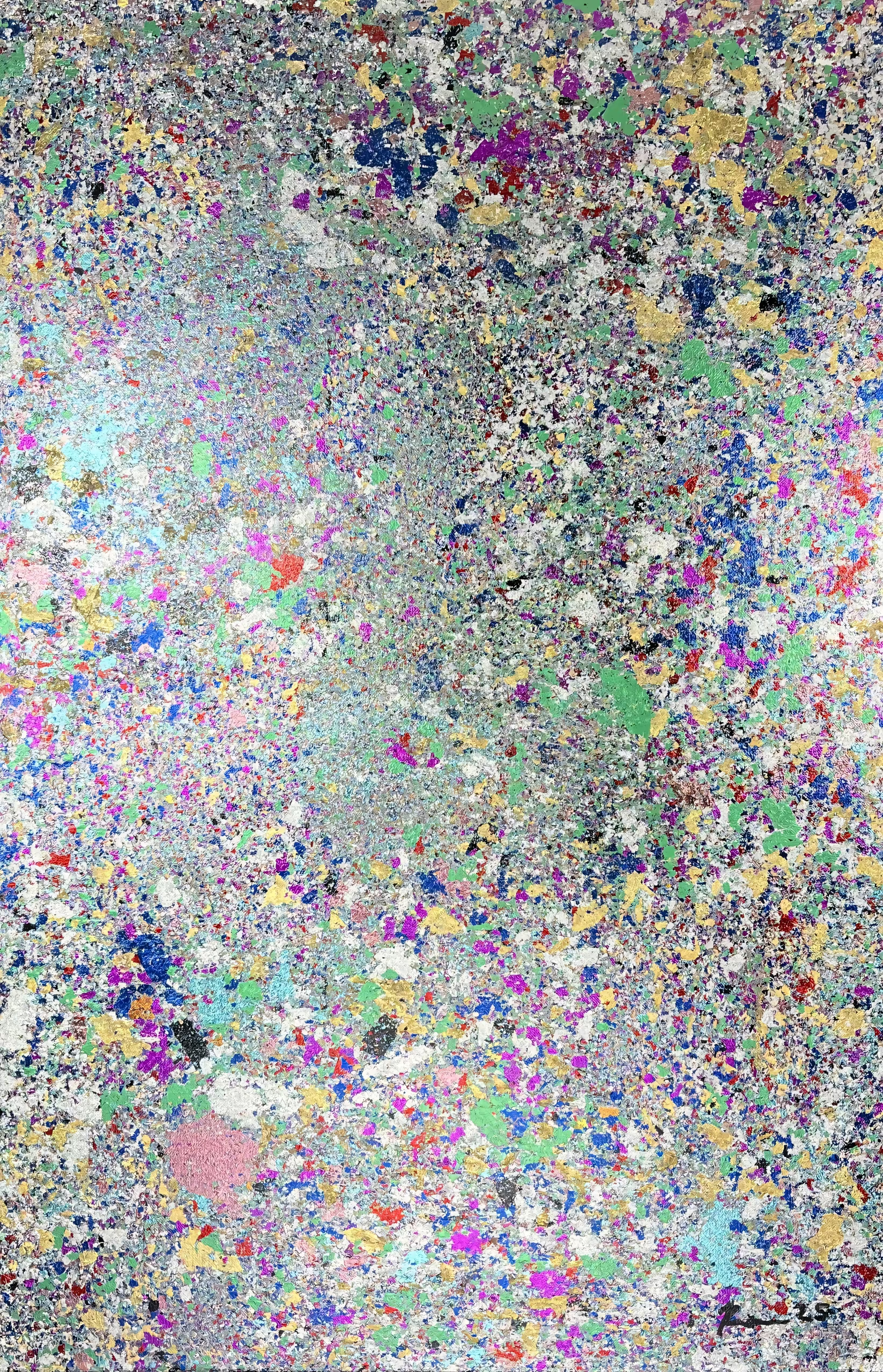
There’s A Face In There
Originally from Jackson, Mississippi, I spent my formative years in Tuscaloosa, Alabama, before gradually migrating north through Tennessee and North Carolina, eventually settling in State College, Pennsylvania. My artistic training is largely informal, consisting of childhood art classes and a single, unsuccessful college course in 2D design.
Acrylic on canvas is my primary medium. My exploration with metallic leaf began as a means of embellishment, but through a series of unintended experiments, it evolved into a distinct style. These pieces represent the initial results of that unexpected journey.
This series explores metallic leaf as the primary medium, moving beyond its conventional use as mere embellishment. Direct application emphasizes its inherent reflectivity, texture, and malleability, creating dynamic surfaces that shift and evolve with light and perspective. Embracing the element of chance, each piece becomes a record of the dialogue between intention and accident, revealing the inherent tensions between control and surrender. This is an exploration of materiality and perception within contemporary painting.

These Truths 1.21.20
Samantha Olschan is an award-winning interdisciplinary artist & designer who works across animation, art, and design for brands, films, media, and experiences. Her creative practice investigates how storytelling, motion design, & experimental narrative can be of service to under-represented and/or under-served communities. Recent exhibitions and screenings include the P.O.V. Series (PBS), The ShortList (PBS), The Connecticut Art Directors Club, Tag Gallery Los Angeles, Las Laguna Gallery, Gallery Omnibus, Hollywood North Film Awards, The William Benton Museum of Art, The Peninsula School of Art, Black Maria Film & Video Festival, New Haven International Film Festival, The Seattle International Film Festival, Boston Cinema Census, Boston Underground Film Festival, FrackFest, Visionfest, Tribeca Cinemas, Bumbershoot, The Gene Siskel Film Center, Marblehead Film Festival, The Skopelos Foundation for the Arts in Greece, and Womenwhodraw.com.
The image references a modern-day David and Goliath. The young girl is not directly identifiable allowing the viewer to project themselves into her/her space. Since its creation, the United States Supreme Court has overturned Roe vs. Wade, its 1973 ruling which recognized that the right to liberty in the Constitution, which protects personal privacy, includes the right to decide whether to continue a pregnancy. This overturning disproportionately impacts women of color in the U.S., as they are more likely to face underlying social and economic inequities.
The image, a 29in x 22in digital print on glass, references a modern-day David and Goliath as told through a young woman and the government/U.S. Supreme Court. The young girl is not directly identifiable allowing the viewer to project themselves into her/her space. The viewer indirectly comes to the image with preconceived bias about who she is and what she is doing.
The image has been captured using digital video and photography and then edited using computer software to enhance the narrative. The Supreme Court Building of the United States, often referred to as “The Marble Palace”, serves as the official workplace of the chief justice of the United States and the eight associate justices of the Supreme Court and is both a site for political protest and tourist destination in America. All evidence of life, outside of the young female subject, has been digitally removed or erased from the frame. Tourists, police officers, signage, and the subject’s hand have been removed from the original image to allow the viewer to concentrate on the relationship between the young women and what was happening inside this building. Her hands are removed to indicate helplessness, her shadow is elongated and enhanced to represent time, age, strength, and staying power. The building itself is skewed dramatically to the right of the frame, whereas the subject occupies the center and left- to mimic political leanings. The temperature of the image was adjusted and enhanced and any indication of softness was removed in the sky through the removal of clouds, leaving only radial striations.

Thinking
Aron Winter is a New York native, but spent most of their life in Florida and grew up in Clearwater. They studied at and graduated from the University of Central Florida in Orlando in 2009 with a degree in Theatre Studies. Their focus was, primarily, on costume and set design. After graduating, Aron spent time working for Walt Disney World as a professional face painter as well as crafting costumes for a local theatre company.
However, life took Aron in another direction and it wasn’t until 2012 that they began creating costumes again to wear to local cosplay conventions. And in 2020, during the pandemic, Aron turned to several mediums, including painting and weaving. Aron now, in addition to costuming, creates paintings and unique woven wall hangings using found objects and finds time to spend on their art every single day.
Exhibitions/Events
- 2023 – Collective exhibition “Made in New York 2023” – Schweinfurth Art Center
- 2023 – Collective exhibition “Material World: A Contemporary Fiber Art Exhibition” – The Arts Council of Fayetteville/Cumberland County
- 2023 – Participation in New York ComicCon’s Costume Contest with an original cosplay/costume – Photographed by Getty Images
I’ve always been an artist in some form or another. When I was young I would draw horses to show to my parents and doodle in the margins of my school textbooks. As an adult, I now paint in the lyrical abstraction style, with my work delving deep into the psyche and expressing how my thoughts and feelings impact my experience in the world.
My work focuses mainly on expressing the complexity of human emotion through color, shape, and texture as though each piece were a page from a diary. While each painting is unique, there is a cohesive visual thread that ties them all together through the use of common shapes and techniques.

This End Up
Jennifer Sugarman is known for brilliantly colorful small paintings that invite the viewer into imaginative dreamscapes. Her work has been accepted into juried competitions nationally and internationally and is held in many private collections.
Born in New York City, Jennifer took her first art class at MOMA at age four, where she saw works of art that have influenced her throughout her artistic career. She went on to receive her MFA from The University of Mississippi and her BA from Northwestern University.
The scale of her watercolors, and therefore interaction with them, is small and personal. Surface tension, brushstroke, and layers of color combine to create depth of field and interest. Jennifer’s application of the watercolor medium is decidedly non-traditional, using a process she has created over years of working with the medium; her saturated colors create an aesthetic that is unexpected and often not recognized by the viewer as watercolor.
My work centers on spaces from my imagination that reflect reality but don’t represent it, much like a dream. While the scale of my watercolors, and therefore interaction with them, is small and personal, my approach to painting both small and large works is similar. Surface tension, brushstroke, and layers of color are equally important no matter the size of the work. I want you to participate when you look at my art – enter my work and place yourself in the space. While my early paintings were primarily figurative, for the most part, figures have disappeared from my watercolors. However, a sense of the figure’s presence remains – you are that presence.