

The Garden
Gayle Faulkner, with over 35 years of artistic exploration and creativity, stands as a seasoned watercolor, acrylic, and mural artist. Her journey has been marked by constant exploration, a playful engagement with diverse media, and an unwavering commitment to growth in the world of art.
Her academic journey, rooted in a BA in Sociology from William Jewel College in Liberty, Missouri, initially led her to work with children, integrating art into their day-to-day experiences. Gayle’s passion for art eventually pulled her into a more immersive pursuit. She delved into Art and Design courses at Louisiana Tech University in Ruston, unlocking her artistic soul. The willingness to ”put herself out there” coupled with years of hard work and a penchant for thinking outside the box, allowed her to undergo a major growth period.
Finally, the challenges posed by the COVID-19 quarantine became a catalyst for Gayle’s artistic metamorphosis, leading her to focus on acrylic paintings on canvas. Engaging in online courses and dedicating countless hours in the studio, has led Gayle to newfound success in her career as an artist.
In her current artistic chapter, Gayle has embraced the multi-dimensional world of layered acrylic painting. These layered landscape paintings pulsate with depth, intricate patterns, and whimsical interpretations, inviting viewers to step into a space that offers a sanctuary from life’s pressures. Her aspiration is clear — to guide everyone towards a place, be it a memory or a dream, where they can meander, savor the fragrance of flowers, feel the gentle breeze, lean against a tree, and simply breathe.
Gayle’s works have graced numerous exhibitions, gallery shows, and juried art festivals, earning accolades and finding homes in corporate and private collections across the globe.
In my art practice, I describe my creations as Textural Acrylics. This term represents the exciting experience of observing paint flow from the palette knife, forming captivating textures and colors. Each stroke channels emotion and every canvas captures a moment of creative inspiration.
My process is spontaneous – I start with a loose outline, sketch the composition, and then fully immerse myself in the act of creating. Throughout the process, music is my closest companion, its volume soaring. I dance to the rhythm, losing myself in the beats, and, on occasion, even letting out a song. My painting process is a multisensory experience, an immersive journey into the fusion of sound and color, where each note becomes a brushstroke and every stroke on the canvas is a dance of creation. I often liken my paintings to cherished children—it’s a relationship that involves nurturing, engaging in heartfelt conversations, and weathering the challenges of creative adolescence with boundless love and patience. With each brushstroke, I invest love, patience, and understanding, allowing the artwork to evolve organically. The end result is akin to witnessing a child mature into a beautiful, fully-formed adult—a testament to the transformative power of artistic expression.
When the viewer engages with my work, I want them to do more than observe; I want them to partake in the sensory journey. Inhale the delicate fragrance of blooming flowers, listen to the subtle rustle of leaves, lean against the painted tree, and simply breathe. My paintings are meant to cease to be static images—they become portals, immersive experiences where anyone is welcome to wander, explore, and connect with the essence of my artistic vision. Through my Textural Acrylics, I aim to create a sanctuary where the boundaries between creator and audience blur, and the shared experience becomes a celebration of art and life.

The Garden Of Chaos
Arlette Stella is a late-blooming, self-taught artist, who took up painting in the Fall of 2019. In spite of her short history as an artist, she has been in several shows and exhibits, both in person and online. Her creative side is informed by her extensive education alongside her travel adventures and life experiences.
Over the last three years, Arlette has been in many shows both online and in person, both juried and not juried.
“For me, to paint is to breathe, to exist. I am an artist!” declares Arlette, surprised and bemused.
Arlette’s boundless imagination and deeply philosophical and abstract nature are evident in every piece that she creates.
Thus, she rightfully terms her art: Abstract/Fanciful Message Art.
And, her message? Kindness.
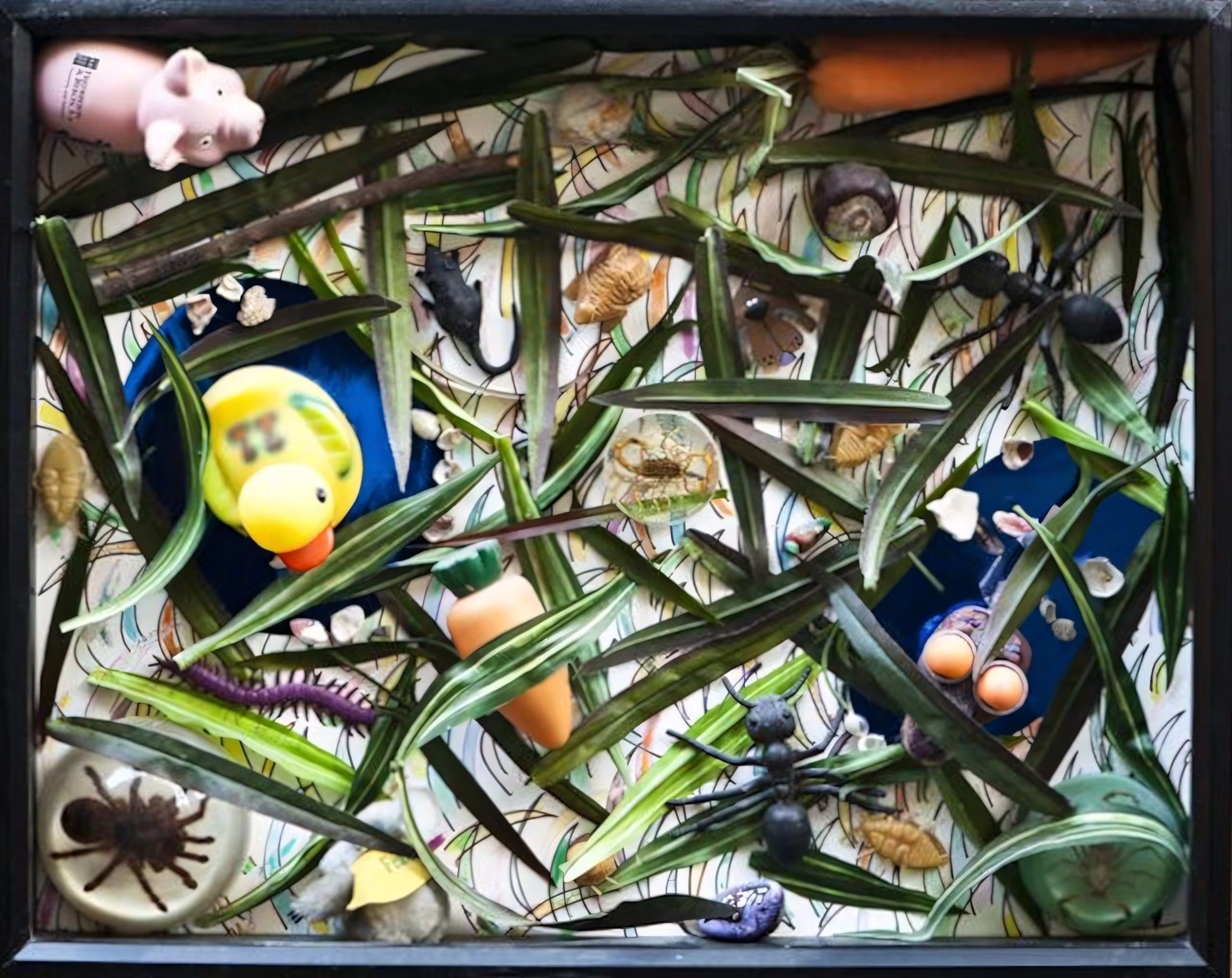
The Garden Of Kitschly Delights
I worked as a newspaper reporter and technical editor for most of my professional career. As a child, I drew cartoons and created comic books featuring friends and family members. Since then, I’ve worked in many different art forms (mostly mixed media), often with historical or nature subjects, often with tongue in cheek, and often incorporating the written word or otherwise commenting on language and meaning. I have been fortunate to have my pieces appear in exhibitions around the country.
“BTLS” takes a jigsaw puzzle picture of the Beatles’ Abbey Road album cover, explodes it into individual pieces, and then fills in the spaces with drawings of fancifully colored beetles mounted kinetically on tiny springs. A well-directed breath of air will animate the beetles, thus making the BTLS interactive.
“The Garden of Kitschly Delights” collects all the gewgaws, tchotchkes, and silly objects that people give you or you acquire over the years and populates a whimsical meadow with an assortment of fun (and maybe not so fun) critters, reptiles, and insects that might delight the enigmatic Hieronymus Bosch himself.

The Gathering
Elaine Weiner-Reed is an award-winning bilingual artist living in Maryland. She earned a B.A. and a B.S. in French (language and education) with a German minor and an undeclared second minor in Sculpture from West Chester University, Pennsylvania (1978, 1979). While working as a French linguist for the U.S. Government, she earned an M.A. in French from Middlebury College, Vermont (1989). She earned a post-graduate certificate in Information Technology and Telecommunications from Johns Hopkins University (2002).
Throughout a 36-year full-time tandem career in the USG, Weiner-Reed systematically pursued and established her art expertise and credentials. Wanting to learn how to transform the 3-D world into a 2-D world of color, she mastered first classical oil painting (1980’s), then watercolors and water media on paper (the 1990s-2005), eventually embracing acrylics and latex (2005-current). Her torn canvas series (circa 2014) heralded her return to sculpture, helped by her stone carving in Myslenice, Poland (2014, 2017) during two invitational international artist residencies. Since 2017, she has been painting and creating plaster and metal figurative sculptures, as well as welded metal music-inspired assemblages.
Throughout her art career, Weiner-Reed has distinguished herself as an abstract expressionist artist with an uncommon vision. Her art qualifications include juror, lecturer, blogger, committee member, and instructor. Weiner-Reed takes her role as an artist in society seriously, shouldering it responsibly as a public trust. Her “Every Painting is a Song (Story)” creative transdisciplinary initiative is now in its sixth year (2021). Her artwork has been featured in international exhibitions in China, Hong Kong, India, Italy, Spain, France, Poland, and Canada, and included over 80 international, national, and regional group shows. She earned a lifetime signature artist membership in the Baltimore Watercolor Society and holds signature memberships in the Potomac Valley and Georgia Watercolor Societies, as well as the International Society of Experimental Artists.
Focused on identity as impacted by transience and imperfection, some common themes that run through my work are telling the unknown or hidden stories. Monuments to life, my works resurrect feelings of transcendence, mystery, and hope.
People and relationships matter to me. No two identities or relationships are ever the same. I see beauty in humans as they are, each person a unique and multifaceted three-dimensional tableau. My figurative paintings are created to selectively reveal or conceal emotions and storylines, the implied content in a scenario communicated through form, gestural strokes, colors, and other design elements. Some of my characters are defined, while others appear as silhouettes or after-thoughts. I leave each piece open to interpretation and imagination.
My creative process involves analyzing and then building a character in layers, mimicking the way in which identities are formed throughout a lifetime: layer by colorful or complex layer. In my paintings, I let the form and placement of figures imply subsurface content and emotion.
In my figurative sculptures, I explore the physicality and dimensions of those layers, juxtaposing strength and inner beauty with vulnerability and external imperfections. Highlighting the imperfect in a world that embraces limited definitions of beauty, my goal is to challenge those perceptions and transform the definition of beauty in the 21st Century.

The Gathering
Ms. Lieberman is a New York based artist who shares an apartment overlooking the Hudson River with her husband and Bichon Frise, She studied fine art at the School of Visual Arts and Textile Design at Parsons School of Design and Fashion Design at FIT in New York City and began her art career as a textile/ surface pattern designer within the fashion and home furnishings industries creating patterns for Carole Little Industries in Los Angeles, California, and Liz Claiborne in New York as well as independent textile design studios throughout her 30-year career. Upon retirement from the fashion industry, she continues to utilize patterns throughout the representational artwork she currently creates often drawing inspiration from both the natural world, through travel, and the urban environment. This fascination with pattern is not just aesthetic, but also philosophical. For her, patterns represent the underlying interconnectedness of all things.
Her unique collages are a fusion of traditional and digital techniques. She starts with hand-drawn or painted elements, sometimes scanning and manipulating them digitally. This process allows her to experiment and iterate her works, often playing with enlarged scale, color placement, and pattern orientation to create her distinctive collage pieces. In her future projects, she plans to explore new mediums and techniques, pushing the boundaries of what is possible with patterns and collages.
“The Gathering” is a mixed media collage utilizing original and vintage surface pattern designs and acrylics on 30 x 30 inch canvas. It seeks to explore the complexities of human connection and shared experiences. The title signifies a coming together, a collective convergence of individual paths and is a tribute to the shared human experience and common threads that bind us all despite our differences. This work invites the viewer to delve into the intricate layers of collaged patterns, to uncover hidden narratives of the group around a table, and to perhaps reflect on their own experiences of connection and community.

The Gathering
I am a Digital Artist who uses Adobe Illustrator 9 and Adobe Photoshop 6. I create my world through points, lines, and color. Chuck Jones, the animator, and Loet Vanderveen, the sculptor, and the artist Erte have been monumental influences on how I approach line work and form. Precision with a lot of chaos and whimsy. I fell in love with drafting in architectural school where I earned my degree. I have been a digital artist for nearly 38 years but have just begun to exhibit my work publicly in the last year or so. I am now ready to share my individual perspective with the world and I hope can give in return a little happiness as well.
I want to record what I see and what touches me. Drawing it, creating a specific encounter at a particular time of day. Enabling me to capture an experience that brings joy that is singular to me. This is why I must draw. It truly gives me a respite from the world where I can control my little part of this Universe. My refuge and mission is to create something that brings beauty and happiness to me first. But, if my art and images can touch the hearts of others and bring a smile to them, then I know I’ve done a good job.

The Geometry Of Twilight
Bruce Williams is an abstract painter and professor of Cultural Studies at William Paterson University of New Jersey. Born in Great Falls, Montana, Williams studied at the University of Pennsylvania, completing an M.A. with an emphasis on German theatre. He subsequently earned a Ph.D. at UCLA, where his doctoral dissertation explored the relationship between cinema and poetry in Brazil. His many multilingual publications have dealt with cinema theory and history, photography, and the relationship between poetry and the visual arts.
Growing up painting traditional landscapes, Williams moved to abstraction while a doctoral student in Los Angeles. Several years ago, he returned to painting as a natural extension of his research. His paintings have appeared in juried exhibitions, both in-person and virtual, throughout the United States. One of his most recent solo exhibitions, “Topographies of Curiosity,” was held virtually and curated by Kledian Myftari of Prague.
A monograph on Williams’ art his work was released in Russian in Gdańsk, Poland, in November 2025. Edited by Anna Stepanova, Где свет иной (Where the Light is Different) draws on the poetry of Alexander Blok to probe the relationship between inner and outer light — between illumination as revelation and as erasure. The book’s title reflects the heart of Williams’ work: how light can hold memory without possessing it, how the past can shimmer just at the edge of perception.
My painting practice is an act of excavation — a continual attempt to retrieve what resists naming. Each canvas begins as a search for the invisible architectures of memory: traces of a gesture, a place once inhabited, or a voice that has dissolved into silence. I paint to understand how absence becomes form — how what cannot be said still insists on appearing.
Trained as a scholar of cinema and language, I have always worked at the threshold between the seen and the spoken. My early research on Brazilian and Eastern European avant-garde film revealed to me that every image carries the memory of time passing — not as a narrative but as an emotional residue. Painting allows me to approach that residue directly, without dialogue or plot, through color, texture, and the layered rhythm of marks. The surface becomes a palimpsest where light, loss, and perception meet.
The visual language I have developed relies on the tension between containment and rupture — veiled planes interrupted by sudden intrusions, fragile transparencies coexisting with dense accumulations of pigment. These formal contradictions mirror the deeper human ones that interest me: fragility and endurance, intimacy and distance, the persistence of beauty in the face of decay. Every composition is a negotiation between order and the moment when order gives way.
In each painting, color functions not as decoration but as emotional structure. I often begin with subdued, earth-toned greens, browns, muted yellows — and then work toward what I call “intervals of luminosity”: thin passages of translucent pigment where breath enters the surface. These intervals recall the suspended pauses in music or film, the instants that precede recognition. They are spaces where the painting breathes and where the viewer may find their own reflection.
My process is deliberately slow and iterative. I build layers, sand them down, and rebuild — allowing time itself to leave a visible trace. This pacing resists the acceleration of contemporary culture and affirms painting as a medium of attention. Each work holds within it the history of its making — the reversals, hesitations, and recoveries that define human experience.
Underlying all of this is a deep concern with humanism — with the capacity of art to bear witness to the persistence of meaning even in the aftermath of loss. I am drawn to moments when language falters: when words no longer suffice, and only color remains capable of speaking.
Ultimately, my aim is to create spaces of stillness and resonance — paintings that invite the viewer not to decipher, but to inhabit. Each work asks: what remains when speech ends, when image becomes echo, when the visible world dissolves into its own afterglow?
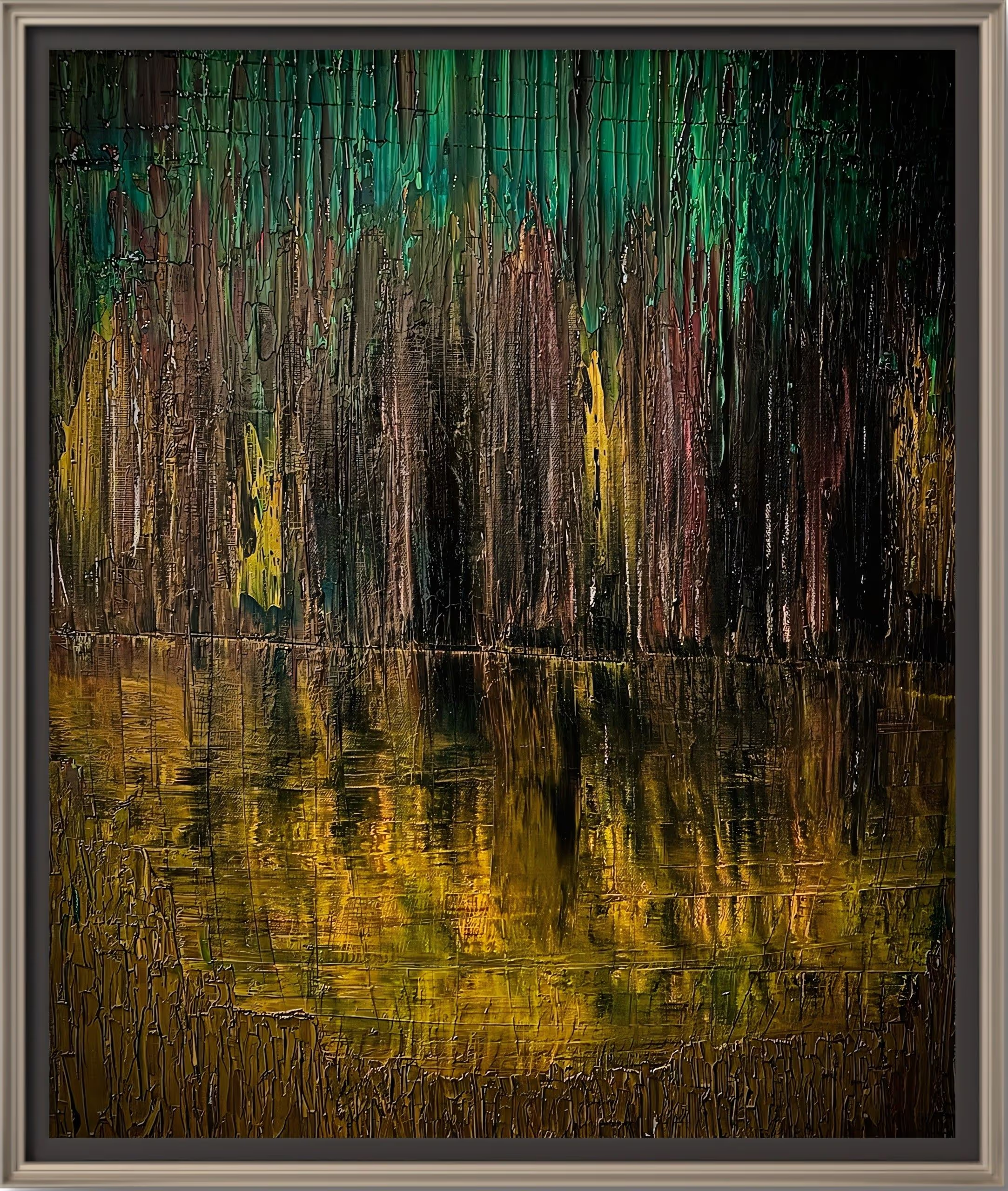
The Gilded Abyss
Jon Feraro is a New Jersey–based emerging artist whose work is rooted in resilience, discovery, and the quiet transformation that comes from life’s most demanding chapters. At 53, his artistic practice developed not through formal training, but through lived experience—shaped by a three-year battle with cancer, now in remission, and the deeply personal act of caring for his mother after a devastating hip and femur injury.
It was during this period of caregiving, reflection, and emotional intensity that Feraro first began to paint. What started as a private, intuitive outlet quickly revealed itself as a natural and necessary form of expression. Without academic constraints, he developed a process driven by instinct—layering, scraping, and reworking surfaces in a way that mirrors both physical endurance and emotional complexity.
Working primarily in oil, Feraro creates heavily textured, abstract compositions that evoke psychological landscapes rather than literal scenes. His work often explores tension between structure and erosion, control and release—echoing themes of fragility, healing, and persistence. Rich, earthen palettes—deep greens, oxidized golds, charred blacks—suggest cycles of decay and renewal, while vertical forms and reflective passages hint at memory, presence, and reconstruction.
Feraro paints under the name Inner Terrain Studio, a concept that reflects his belief that the most compelling landscapes are internal. His work invites viewers to engage with ambiguity and to project their own emotional experiences onto the surface, creating a shared space between artist and audience.
Outside the studio, Feraro works full-time as a technical recruiter in New Jersey—a role that sharpens his ability to connect, observe, and understand people, qualities that subtly inform his artistic voice. Balancing a professional career with an evolving creative practice, he represents a growing movement of self-taught, later-in-life artists who bring depth, perspective, and authenticity to contemporary abstraction.
Now emerging onto the gallery scene, Feraro’s work stands as a testament to reinvention and the enduring human capacity to create meaning from adversity. His paintings are not just visual experiences—they are records of survival, presence, and the ongoing process of becoming.
My work emerges from a search for internal landscapes—places shaped not by geography, but by memory, pressure, and emotional residue. Through oil and heavy texture, I explore what I call “inner terrain”: layered environments that mirror the complexity of lived experience. Each painting is less a depiction and more an excavation—built up, scraped back, and reworked until something honest begins to surface.
Working primarily with palette knives and dense applications of paint, I’m drawn to the tension between control and collapse. Vertical striations, fractured planes, and reflective surfaces often appear in my work, suggesting structures that feel both constructed and eroding. There is a push and pull between order and entropy, between what we hold together and what inevitably breaks down. Color plays a psychological role—deep greens, oxidized golds, and earthen tones evoke growth, decay, and transformation all at once.
The piece shown here reflects that duality. It hints at a horizon, a reflection, perhaps even a landscape—but never fully resolves into one. I’m interested in that ambiguity, where viewers project their own narratives into the work. What feels like a forest to one person may feel like a city, or a memory, to another. That openness is essential to my process.
I create under the name Inner Terrain Studio, which represents both a philosophy and a practice. It is a space dedicated to exploring the internal world through material experimentation and intuitive mark-making. As an emerging artist, I am less concerned with arriving at a fixed style and more focused on developing a visual language that remains responsive, evolving, and honest.
Ultimately, my goal is to create work that feels lived-in—pieces that carry weight, tension, and a sense of presence. I want the surface to hold history, to reveal evidence of its own making, and to invite viewers into a quiet but visceral dialogue with themselves. In a world that often prioritizes clarity and resolution, I’m drawn to the unresolved—to the spaces where meaning is still forming.

The Great Beauty
Perhaps because she is from Connecticut, Barbara Bose is one of those people who loves to connect the dots, seek the hidden picture, the lesson, the meaning, the purpose lurking within or underneath any- and everything. The hidden chalice in the Highlights magazine illustration. The oracle of the car radio. A chance bird swoop perfectly timed as if in confirmation of a thought. A word synchronistically repeated from seemingly random sources. Like an alchemist, Bose takes delight in seemingly random elements conspiring to build something new and heretofore unimagined. She keeps this concept in a little purse of ideas she carries around invisibly, fermenting and growing them until they gel into artwork. She is certain that clues are always there because she believes that with faith and perseverance an underlying picture gradually emerges from the soup and that intelligence lies behind situations, and lessons are to be learned everywhere.
A retired illustrator, art director, and designer from the publishing world, Barbara Bose is happily painting in her South Florida studio.
70s:
Boston Museum School: studied painting, printmaking
Freelance illustrator: ad agencies, various art departments
80s:
Quincy Patriot Ledger: created art department, news illustration & layout
Boston Herald Sunday Magazine: design & photographic art direction
The Palm Beach Post: illustrator and designer
International Fine Arts College, Miami: taught advertising & production
South Florida Magazine: design & photographic art direction
90s:
Blockbuster Entertainment Magazine: launched, design & photo art direction
Ocean Drive Magazine: launched, design & photographic art direction
Miami Herald: layouts, special sections, illustration
BoseArts: my design business
Absolutely Florida: published my online travel magazine
Florida.TV: online videos, launched, editor & producer
The Real Food Revolution: documentary editor & producer
00s – 10s:
DC & FL web, video, graphic, and stage design, Washington DC
Wrote & illustrated award-winning novel, Tree of Lives
20s: painting in her South Florida studio, exhibiting in local and out-of-state galleries and online
The Great Beauty: A friend snapped a blurry photo of a woman looking at him while he zoomed past a market in Morocco. I love the random, split-second connection between two total strangers of a tourist passing by someone going about her day shopping halfway across the world. Her beatific pose suggests a blessing – and I feel blessed with the beautiful truth that whatever our personal reality, we are all connected in time and space. Now she waves to me from my bedroom wall. While painting her, I wondered if she’d been shopping for her kid or grandkids.