
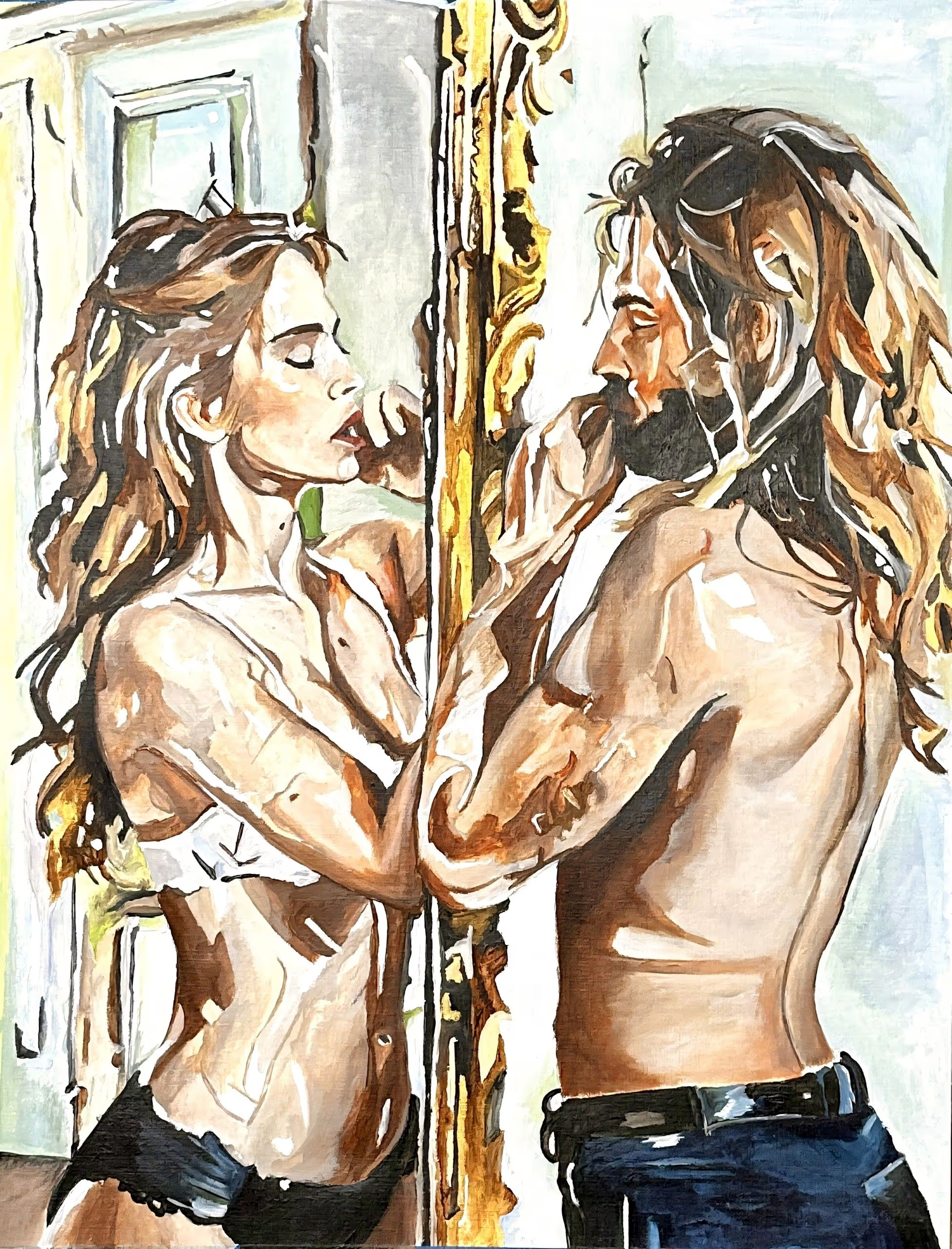
Tell Me How – Image 7
Leigh Witherell is an award-winning emerging contemporary Figurative artist living in the United States. Her work captures scenes of human emotion, often reflecting profound and intimate moments.
Characterized by organic, earth-tone color palettes and dynamic brushwork, her paintings often evoke deep emotional and provocative responses born from significant life traumas, such as the death of her daughter in April 2021. Her work looks to show how emotions play a prolific role in how we see the world, and when we hide those emotions, we see the world as gray. Her choice of bold colors and romantic compositions leads the viewer into a fantasy that, for the artist, is a solace.
Significant projects include a series of works that portray the silent, powerful moments of interpersonal relationships. As an international artist, she has shown in many exhibitions, both group and solo, and published in multiple magazines. Her works can also be found in many private collections around the world.
I work in the multifaceted and often contradictory emotions that define intimacy in many forms. My work reveals the raw emotions intrinsic to the human condition, and my subject matter is drawn from the world around me and the institutions that affect us all. I am captivated by compositions that convey a story or a feeling that resonates deeper, reflecting the beauty, complexity, and sometimes the stark realities of the human experience. My fascination lies in the rawness of the human experience, the truths we often hide from the world. I seek to capture and share this authenticity, this unfiltered emotionality, through my work.
My work conveys the vulnerability that has arisen in my work since the death of my daughter in 2021. These works explore longing, sadness, and intimacy, and are meant to start quiet conversations about the many things we never say aloud. At the end of the day, these works convey the raw, unspoken truths of being human and are the things I now say aloud.

Temptation, Pink
Born in Beijing, China, Wenli’s interest in drawing started to show in her early childhood and has become her focus ever since. She graduated from the Beijing University of Civil Engineering and Architecture in the 90s, and following her passion for literature and arts, worked as a journalist/editor for many years. In 1998, she started studying at the San Francisco Academy of Art University, majoring in Graphic design.
After a few years working as a graphic designer, she had a chance to live and travel to many places in Asia, America, and Europe, experiencing and studying both eastern and western culture and history. She finally dedicated herself to fine arts, becoming a full-time professional artist in 2006. Her work includes abstract and figurative paintings.
My work includes abstracts of varying emotional pull, from mellow and flowing to dark and intense. I make effort on leaving the viewer peering in deeper as if to capture the emotion and hold it. My most recent works also include figurative paintings that try to transport my art viewer to another realm. I work on making my subjects ethereal in their beauty and femininity. And it comes through in the personalities of the subjects, each holding a piece of the serenity found within my soul.
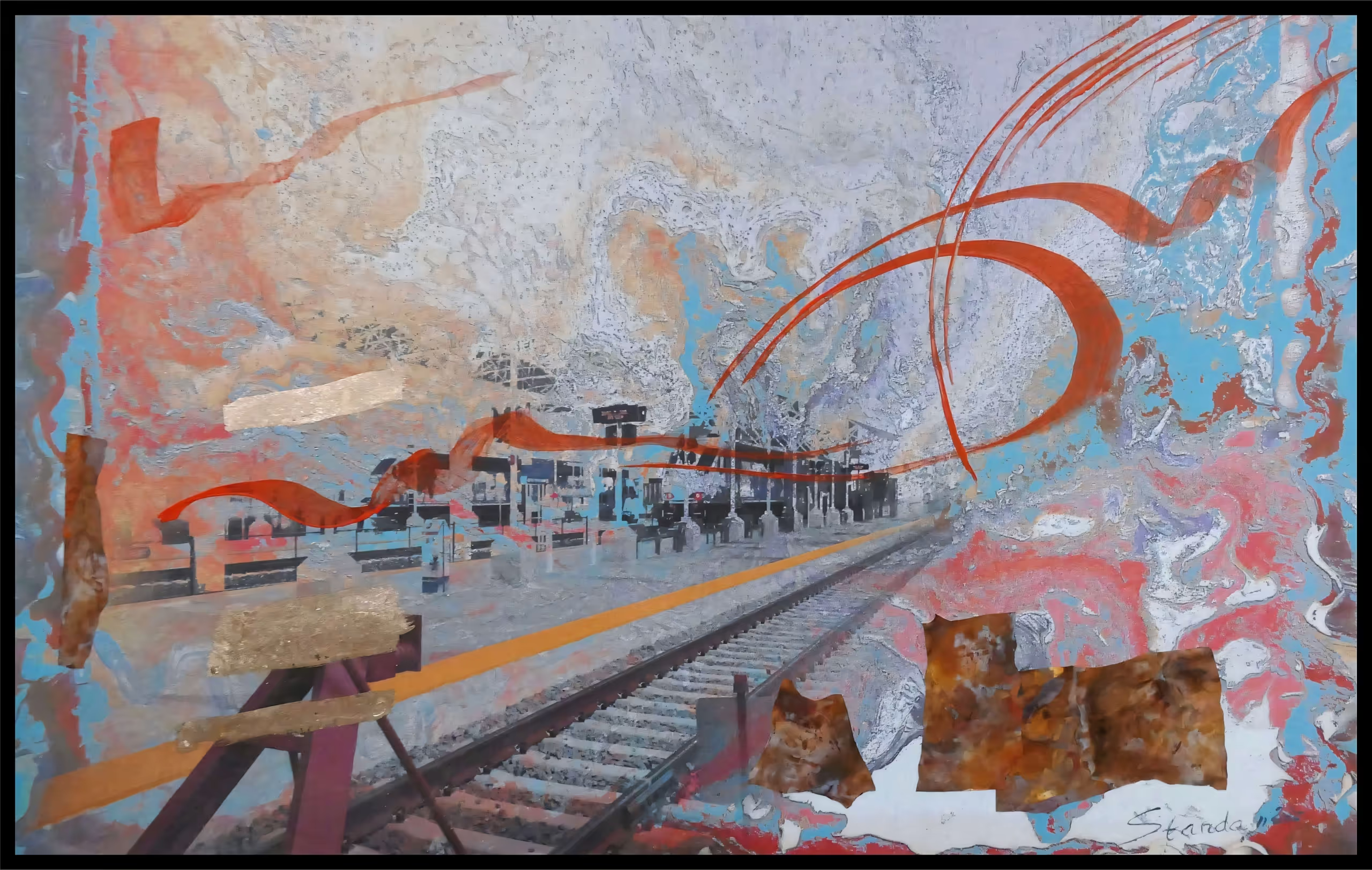
Tempting Horizont
Stanislav “Standa” Riha
Visual artist, photographer, and writer
Member of CARFAC
Born in 1952 in Prague, former Czechoslovakia. He grew up in Lesser Town (Malá Strana), surrounded by great medieval and modern art and artists that caused his desire to create. From early childhood, he enjoyed drawing and later painting; as a young man, he focused mainly on surrealism. His artistic attitude was shaped by many art courses in childhood, followed by art training by MgA Milos Saska and work in the set production of the Realistic Theatre.
In 1980, he lived for a year in Grinzing, Vienna, Austria, and then moved to Vancouver, BC, Canada. Enchanted with the natural beauty of British Columbia, he dedicated the first few years to realistic nature themes and then switched to Surreal and later Surreal-abstract creative work.
In the last three decades, I have been creating wall-mounted, cast resin, and aluminum sculptures combined with canvas and gold leaf, and exploring the computer as an art tool for creating digital artwork.
All my life, I have loved to create art full of emotions and feelings, “soul,” with the satisfaction of fun. I am interested in the balance and composition of colors and objects rather than the reality of the items.
The direction of the last two decades has been aimed at understanding and, through artwork, expressing the human struggle of emotions and adaptations. For the past ten years, I have been polishing my creative work in the Surreal-abstract style.
The main motto of my artwork is: Just as in a good story, the readers have space to create their image; in a good picture, the viewers can form their own account.
Tenacity
My story is about change and evolution, fueled by a passion for communication through art. I believe in the power of art to communicate. I believe in the power of creativity to challenge viewers and ultimately elicit understanding. Simply put, I believe in the power of art. A common thread throughout my evolving career has been communication. As a professional artist, I use art to communicate contemporary life and its stories.
My work has been in numerous one-woman and group exhibits, and received national and regional awards. I have been a juror of art competitions and was also a technical fine art consultant and advisor for Grumbacher and Prismacolor, along with developing a training program for Blick Art Supplies. My artwork is in corporate, university, and private art collections in North America and Europe.
Babler’s work has been juried into: 38th September Competition – Alexandria Museum of Art juror Erika Mei Chua Holum, Associate Curator – Blaffer Art Museum; “Reflecting 2025”– Maryland Federation of Art; 38th Annual McNeese National Works on Paper Exhibition; “In the City” exhibit juror Christina Gomez (Art Institute Chicago); North American Print Biennial juror Elizabeth M. Rudy (Associate Curator of Prints Harvard Art Museums, Boston); Dubuque Museum of Art Biennial juror Pamela Hugdahl (Executive Director, Rochester Art Center); Rockford Art Museum Biennial Juried Exhibit of Contemporary Artists; Andrew James Wulf, Ph.D. (Director – Albany Museum of Art); Gary Freeburg (Professor/Director of Duke Hall Gallery of Fine Art at James Madison University); Amanda C. Burdan (Associate Curator – Brandywine River Museum of Art); Christiane Paul (Curator of New Media Arts at the Whitney Museum of American Art); Felice Frankel (Science photographer/research scientist); Malcolm Daniel (Curator of Photographs – Metropolitan Museum of Art, NYC); Kenneth Baker (Art Critic, San Francisco Chronicle); William Lieberman, Director of Zolla/Lieberman Gallery – Chicago; Annette Carlozzi (Sr. Curator at Blanton Museum of Art); Dr. Jefferson Harrison (Chief Curator Chrysler Museum of Art); Charlotta Kotik (Curator of Contemporary Art Brooklyn Museum of Art); David Houston (Chief Curator – Ogden Museum of Southern Art); Dr. Russell Panczenko (Director – Museum of Art, Madison Wisconsin); Siri Engberg (Walker Art Center); Stephen Phillips (Phillips Collection – Washington DC); Sam Gilliam (international artist); and Ed Paschke (international artist).
She is a Ragdale Residency Fellow and a juried member of the Illinois Arts Council’s Arts-In-Education Roster and has exhibited at Northwestern University, Concordia University, Rockford Art Museum, and the Alexandria Museum of Art. She was also a fine art consultant and advisor for Grumbacher/Prismacolor, along with developing a program for Blick Art. Her artwork is in corporate, university, and private art collections.
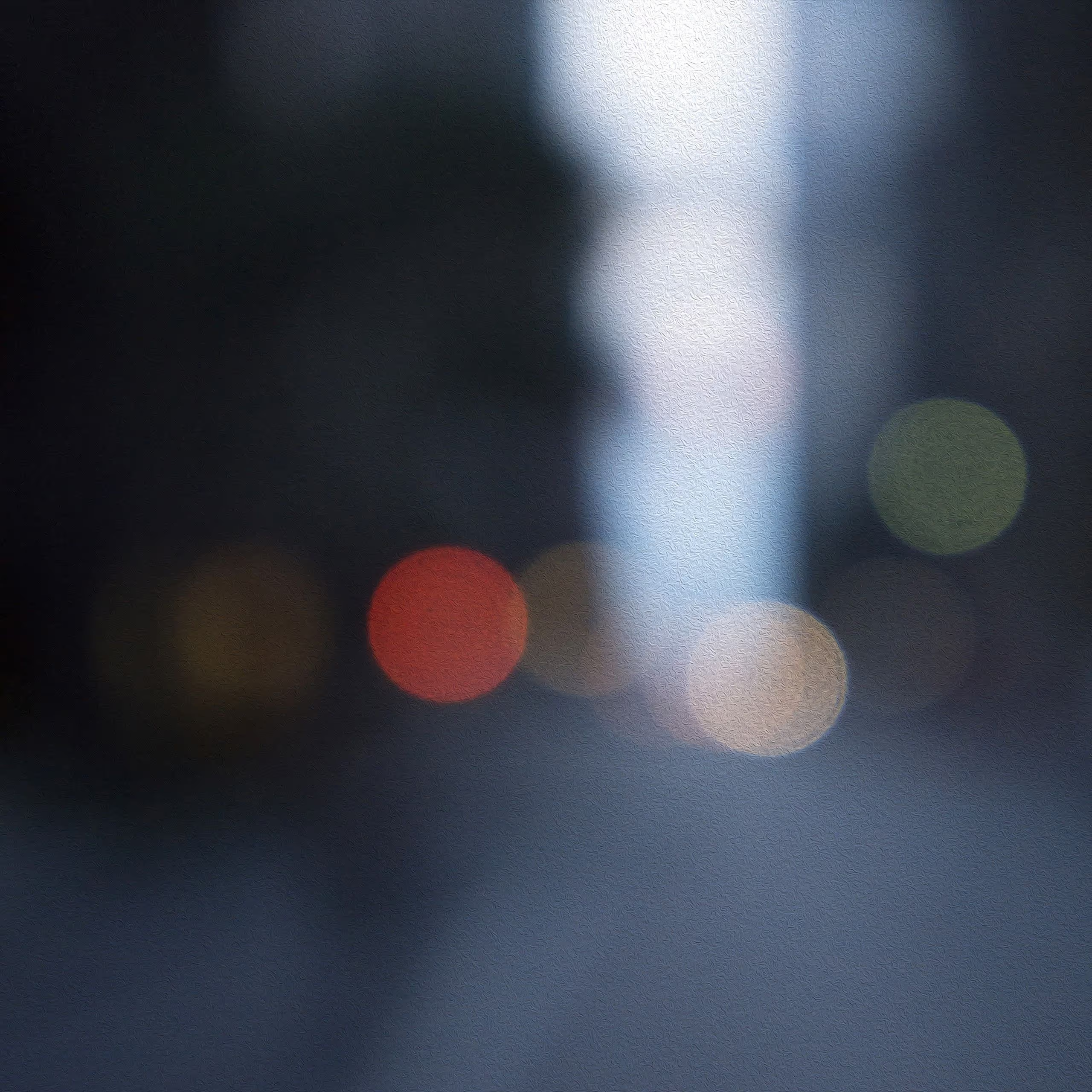
Creative freedom implies risk-taking. To take a risk, an artist must have courage. The courage to explore, to make mistakes, and to move on despite possible rejection. An artist needs tenacity to keep creating. My mixed media piece “Tenacity” visualizes that creative freedom to take a risk. There is a movement of colors merging into one another. A bright light is in the background, symbolizing a sense of freedom to explore creative expression. I create visual puzzles with purposeful ambiguity. A curator has described my artwork as smart and thoughtful and dense with information; gorgeous with color. Mysterious and challenging…puzzles for the viewer to solve.
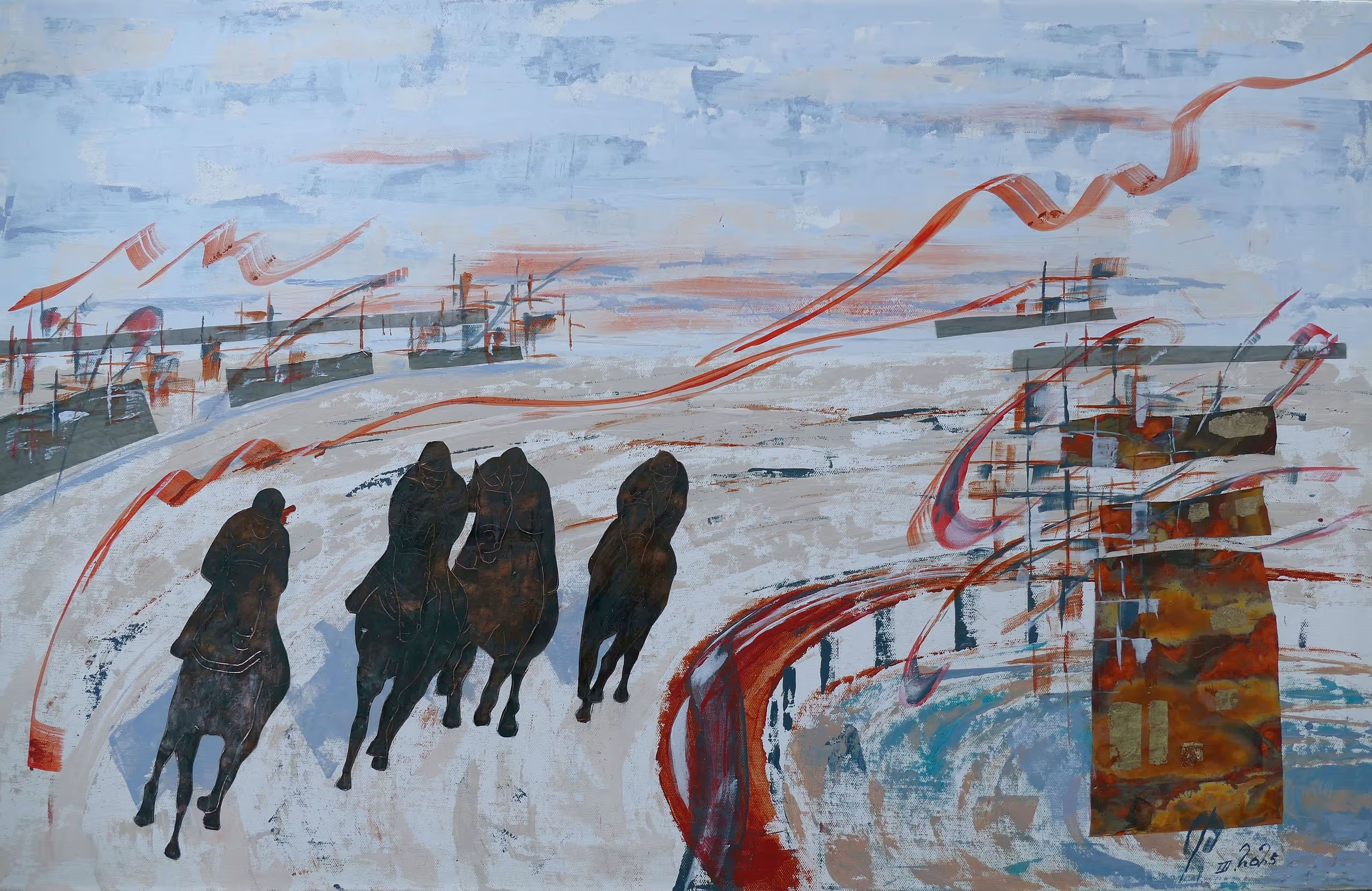
Tense Race
Stanislav “Standa” Riha
Visual artist, photographer, and writer
Member of CARFAC
Born in 1952 in Prague, former Czechoslovakia. He grew up in Lesser Town (Malá Strana), surrounded by great medieval and modern art and artists that caused his desire to create. From early childhood, he enjoyed drawing and later painting; as a young man, he focused mainly on surrealism. His artistic attitude was shaped by many art courses in childhood, followed by art training by MgA Milos Saska and work in set production of the Realistic Theatre.
In 1980, he lived for a year in Grinzing, Vienna, Austria, and then moved to Vancouver, BC, Canada. Enchanted with the natural beauty of British Columbia, he dedicated the first few years to realistic nature themes and then switched to Surreal and later Surreal-abstract creative work.
In the last three decades, I have been creating wall-mounted, cast resin, and aluminum sculptures combined with canvas and gold leaf and exploring the computer as an art tool for creating digital artwork.
All my life, I have loved to create art full of emotions and feelings, “soul,” with the satisfaction of fun. I am interested in the balance and composition of colors and objects rather than the reality of the items.
The direction of the last two decades has been aimed at understanding and, through artwork, expressing the human struggle of emotions and adaptations. For the past ten years, I have been polishing my creative work in the Surreal-abstract style.
The main motto of my artwork is: Just as in a good story, the readers have space to create their image; in a good picture, the viewers can form their account.
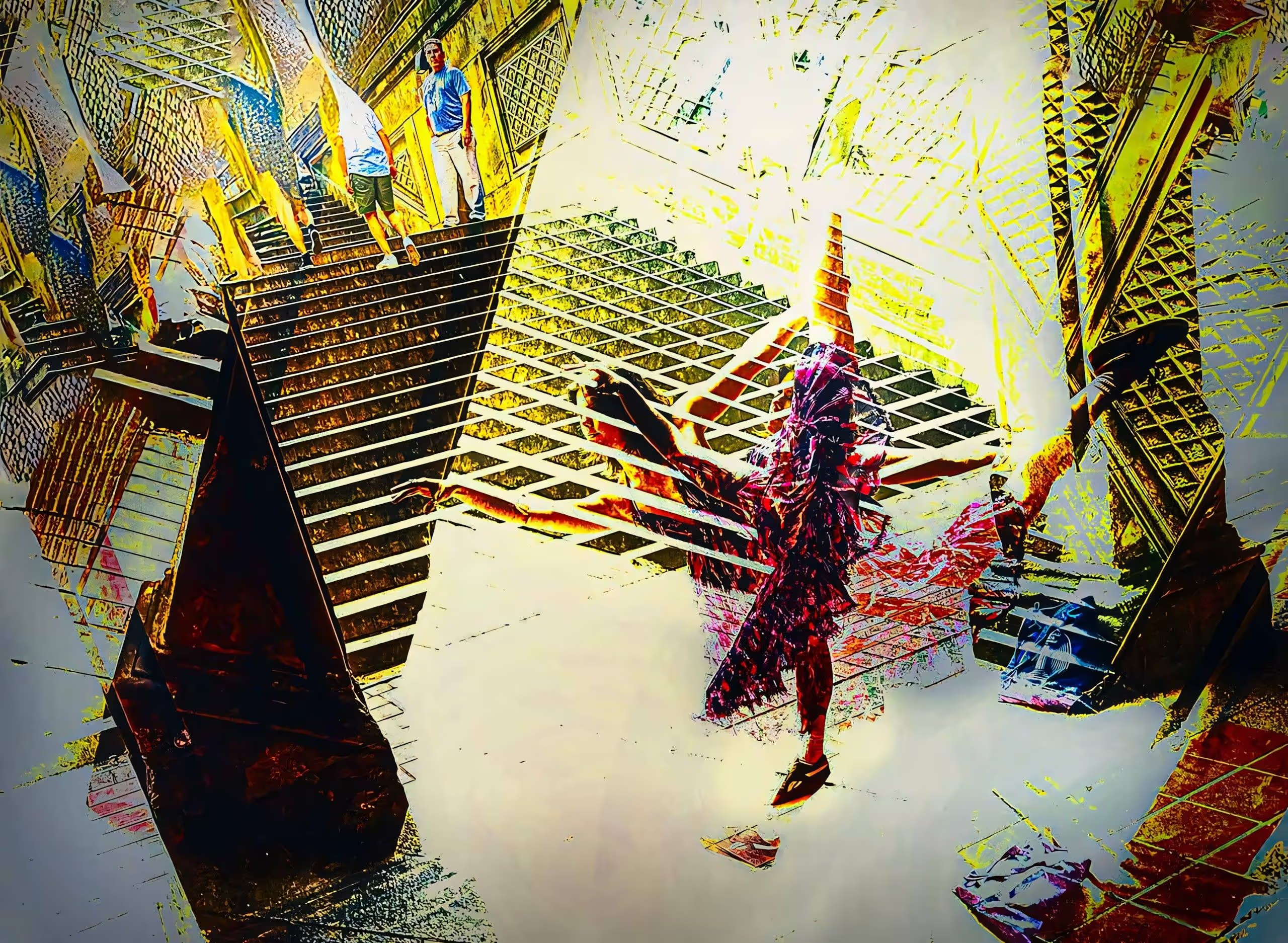
Terpsichore
I have been interested in photography for what seems like forever. I always had a camera, took photos, and read photo magazines. However, it has only been since the development of digital cameras and the digital darkroom that I began to seriously study and develop my skills. I believe the camera and post-processing are tools that the photographer/artist uses to create and share his/her vision. For me, there are no limits on what is an acceptable image.
I am the president of PASFLA (Photo Arts of South Florida), a member of the Boynton Beach Camera Club, and a member of TAOP (The Art of Photography). I am also a member of PSA and have taken many of their courses. I twice received their Photo of the Year award for my portraits. I have won many medals and ribbons in photo competitions, and my black and white photos have been published in Black and White Magazine.
I am currently focusing on infrared photography and ICM (Intentional Camera Movement).
When I decided to get serious about photography about twenty years ago, my goals were to take great wildlife, street, and sports photos. I spent many years and lots of money learning how to do this. I have had some success in achieving these goals.
We try to make sense of a world that is never the same, never stands still. We make sense of it by creating images and telling stories that create the illusion that with a camera, it can be seen as it really is. Most traditional photographers try to freeze a moment in time that captures what they saw and experienced. I still do this, but I believe that by using ICM, a photographer can convey what emotions and feelings they felt at that moment.
Currently, I primarily but not exclusively use Intentional Camera Movement (ICM) and the digital darkroom to create my artworks.
For me, ICM allows the photographer to capture different aspects of reality, so that all the universe, from the smallest particles to the largest, is in motion and share that reality with the viewer.

Terrible Beauty
Gordon Sizelove is a painter who uses geometric forms and vivid colors to express universal themes.
That process of perception has been a lifelong subject of study for Sizelove. As an art educator and then a special education teacher who taught students with dyslexia or had other perceptual differences, he realized the wide range of methods by which people make meaning. “People have to realize that their own mind is constructing what they are seeing,” he comments. This correlates with the modern art world’s movement toward nonrepresentational art and the discoveries of relativity theory and quantum mechanics, all of which emphasize the process of acquiring knowledge rather than settling on any final meaning. His paintings are a way to study “the interface between humans, our minds, and the universe,” the inter-relations of which are inextricable. “We’re not rulers,” he adds, ” but beings in an interdependent way.”
I very much enjoy working with color. I like to experience the interactions of colors and observe the discrepancy between their physical and psychic effects. It seems to me that vision and colors highlight the relativity of our sensory experiences. Light, as it plays upon the eyes, is always changing. It is never fixed and, at times, reveals its fluidity. The light and colors before us can be anything from beautiful to terrifying. The art of color utilizes these qualities in its expression. I bring my enthusiasm to the arts of drawing and painting and I enjoy creating artwork that expresses the vitality that life holds.
I begin my paintings with a line that conveys form, emotion, and meaning. I conceive of this initial line as expressive, and I give it substance by marking it on either side with points of color. As I work, the lines on my canvases become forms, as they are continuously added to. Eventually, they fill up the canvas.
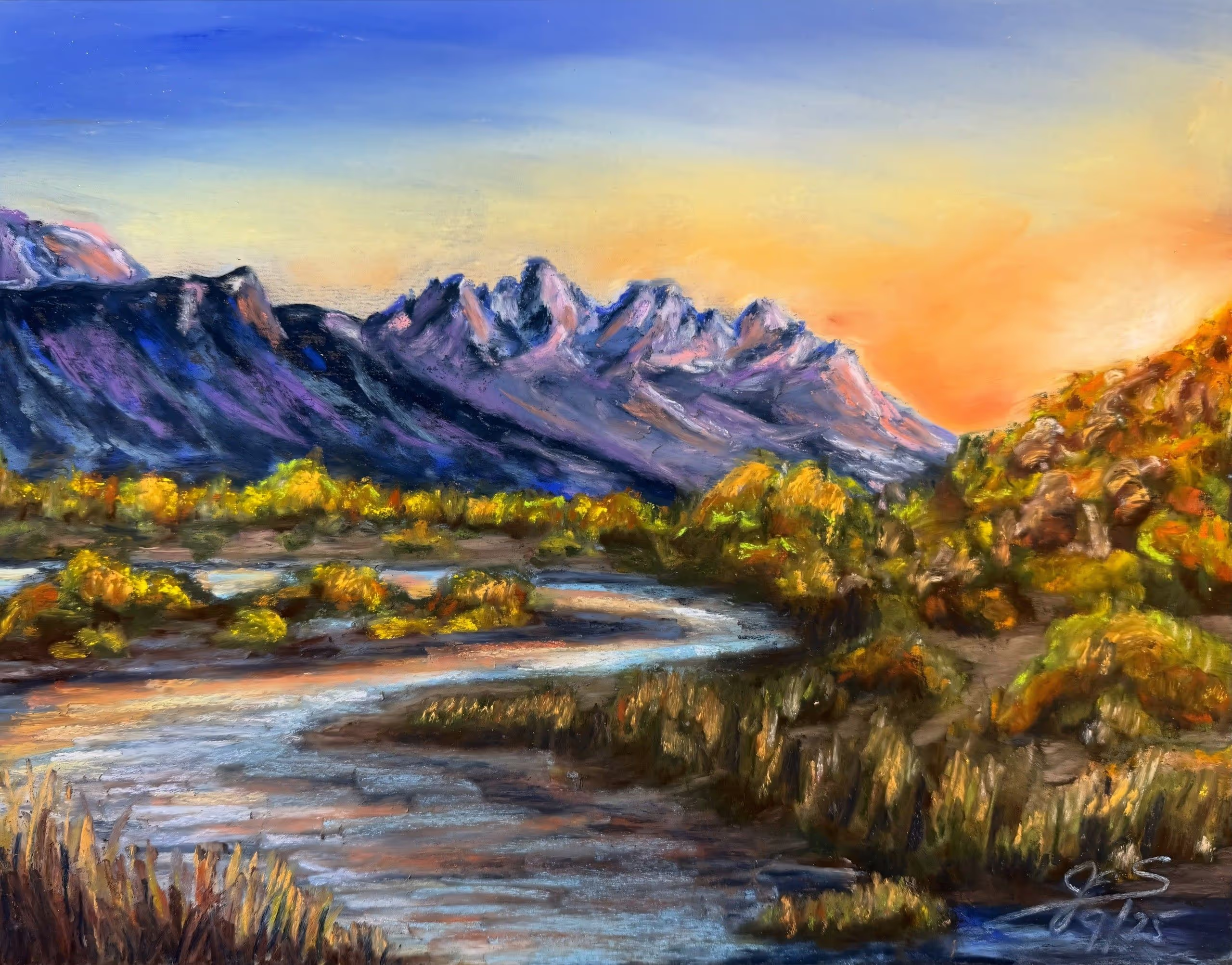
Tetons Sunrise
Jim Slavik has been a creative spirit from an early age, exploring drawing, charcoal, acrylics, and mixed media throughout childhood to high school. Though his artistic pursuits took a back seat to a successful career in finance, he never lost his connection to the visual arts. Upon retiring and relocating to Colorado, Jim rekindled his artistic passion after enrolling in a soft pastel class in early 2023. This experience marked the beginning of his “next act” — a renewed and evolving journey as a visual artist.
Jim’s work spans a range of mediums and subjects, reflecting a spirit of curiosity and experimentation. Since re-entering the art world, he has been honored to exhibit in numerous juried shows and contribute original pieces to charitable fundraisers. Through his practice, he founded Do Good Art, a mission-driven endeavor through which he donates 100% of his art sale profits to charities close to his heart, particularly those addressing cancer and Colorado-based causes. With each piece, he aims to inspire beauty while contributing to a more compassionate and equitable world.
So join him in Doing Good (through) Art.
My art is grounded in a simple yet powerful mission: to Do Good through Art. Every piece I create is both a celebration of natural beauty and a commitment to giving back—100% of the net proceeds from my work are donated to charitable causes.
Inspired by my travels—whether hiking the mountains of my home in Colorado, exploring National Parks, or venturing abroad—I seek to capture the quiet majesty of the landscapes that move me. My work often explores the interplay of light and shadow, the drama of skies at sunset, and the serenity of water in its many forms. From sweeping vistas to intimate glimpses of birds, animals, and wildflowers, each piece invites the viewer to pause, reflect, and reconnect with the natural world.
Soft pastels are my primary medium, chosen for their richness and immediacy, though I also work in watercolor and colored pencil to suit the spirit of each subject. My diverse collections reflect both a deep reverence for the outdoors and a belief in art as a force for positive change.
So join me in Doing Good (through) Art.

Textured Sunflowers
Lynne Mizera, a self-taught, mixed media artist, realized early on that she saw the world differently than most and has spent the past 12 years sharing that vision. Using collage papers she makes herself and acrylic paints and inks, she builds up layers of mediums to create pieces filled with simple shapes and rich with vibrant colors and textures. She recently has become fascinated with the female face and is in the process of creating a body of work embracing the female face and the emotions hidden behind most women’s outer image. Lynne currently lives in the Kootenay Mountains in British Columbia, Canada where she spends her days working full-time in her art studio.
I love creating complex textures in my paintings, using layers of collage and glazes using acrylic inks and paints. This intricate layering process not only creates fabulous texture but also creates translucent layers through which you can see the elements below. The more you look the more you see and I want the viewer to get lost in the layers of paint and paper.