
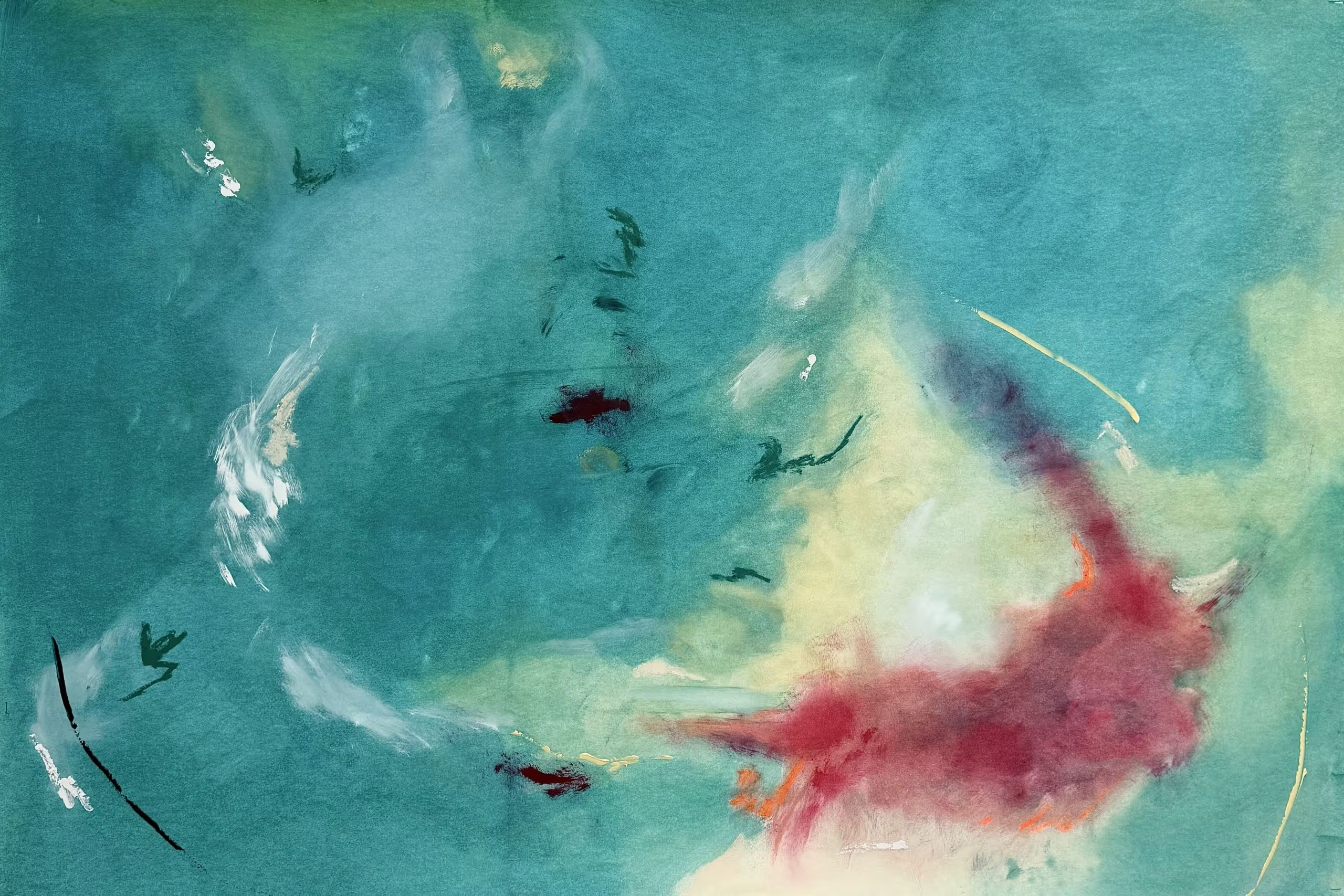
Green In Blue
Jenna Maclean is an abstract, gestural artist, known for her particular focus on the intuitive approach to mark-making. She currently holds a First class honours degree from Duncan of Jordanstone College of Art & Design, Dundee. At the present time, she undertakes a master of letter’s degree in Fine Art at The Glasgow School of Art. Maclean has exhibited throughout Scotland, including Dalkeith Palace for the Visual Arts Scotland Centenary Show.
My paintings explore themes of memory, the subconscious, and human experience.
In my practice, immediacy is important throughout the process. This immediate, intuitive approach of painting forgoes any sort of control or restriction. My work thrives on intuition. It is the backbone of the creation process. This allows me to enter a meditative state of sensory exploration. Through my master’s research at The Glasgow School of Art, I investigate how sound, environment, and material contribute to the application of Gestural mark-making.
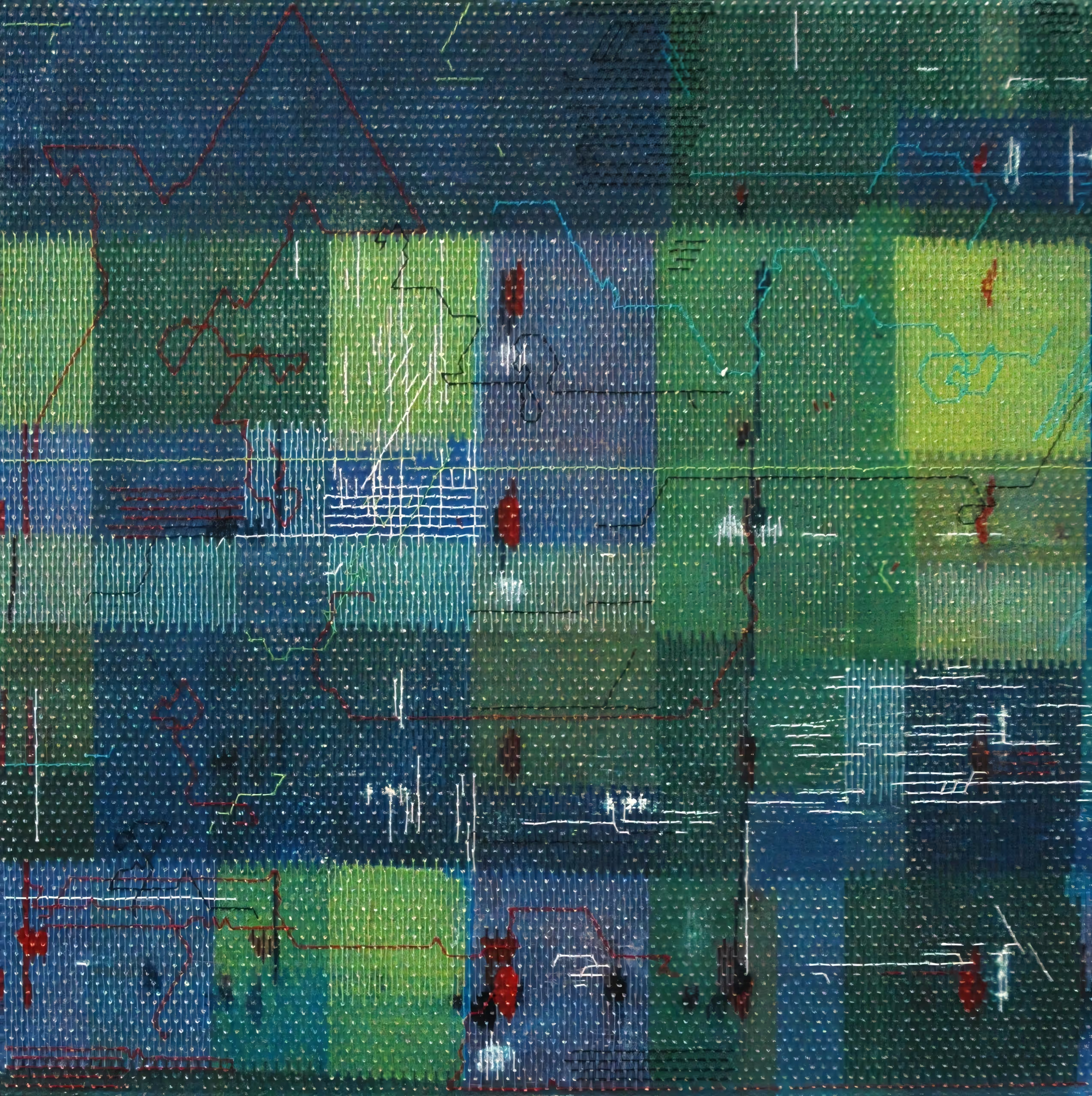
Green Pastures
Herbert Appelson was born in 1937 in New York City; studied at Brooklyn College, received his M.F.A. at the University of Wisconsin, and an Ed.D. from Columbia University. Appelson specializes in printmaking and the relief technique. The graphic pieces in the exhibition, which he calls “hand-threaded embossments,” are dimensional compositions in form, line, and texture. They are prints that activate the flat surface of paper and possess true sculptural qualities.
Appelson’s prints have been featured in many shows, including the A.A.A. and Macy Galleries in New York, the Art Alliance and Woodmere Museum in Pennsylvania, and the Trenton State Museum in New Jersey. In addition, his works are represented in a number of public and private collections such as the Noyes Museum, Kansas State, Auburn, Columbia, and Wisconsin Universities.
My present works, which I call “hand-threaded embossments,” are an attempt to combine papers and threads into a creative art medium. I wanted to create prints that activated the flat surface of paper and possessed true sculptural qualities.
Working primarily with geometric designs, the paper was embossed or folded into three-dimensional shapes. The dimensional facets of these shapes were further increased by the use of an overlay of different kinds of threads. This embossment process represented a dual experiment: on the one hand, it expressed the beauty of the matrix; and on the other, it created a sculptural composition in form, line, and texture.

Green Tara
Charlene’s art journey started at a young age, from about the age of 5 until around 15 she used to paint alongside her Granny using oil paints. Charlene went on to graduate from the University with a Bachelor of Fine Arts Degree. She has explored a wide variety of mediums including printmaking, charcoal, pencils, acrylics, inks, and watercolor painting.
One of the most significant moments in her life was losing her sister to depression. Following this event, Charlene has made it her goal to release kindness and happiness into the world, usually through her art, but often just by simple everyday acts of kindness, like complimenting a stranger. Having suffered from mental health issues herself, Charlene understands the inner turmoil of feeling depressed and wanting to be happy. Of succumbing to feeling grief but staying in control of those emotions without letting them overwhelm you. Of trying to feel things as opposed to bury those feelings.
She uses her art to help keep her mental health and is currently exploring meditative art. Her aspiration is not only to be happy, but also to release positive emotions into the world, be that via her artwork, or her honest demeanor as a human.
This is my green Tara. This painting consists of 20-30 layers, each of which is an attend to represent some of her many qualities. I never knew what Tara was until recently. She is the female Buddha and has many complexities about her, as do we as human beings. Some of what she teaches is that we all possess her qualities, it’s just a matter of learning how to tap into them.
This painting is symbolic of the Tara that is within me. Of the journey I went through during the layers and layers of painting her. The journey of believing that I am enough and that I can trust myself, both with life and with my painting. I am not enlightened, but I am on the journey. I don’t think I’ve ever poured more of myself into a painting than I have with this one. She brings me hope and makes my soul happy, I hope that she makes yours happy too.

Greeting The Dawn
Rich Wagner grew up with art – his mother was a professional artist and his father was an amateur artist. Thus, his initial artistic training was in their atelier. Following 250 credit hours of formal study, Rich was elected a member of the Art Students League. He has also studied painting at the Royal Academy of Fine Arts in London. In addition, he has studied art history, most recently at the Courtauld Institute and the University of Oxford.
Examples of his work are included in private collections and in the Law Library at Pace University. He often participates in exhibitions and his works have also been shown at Gallery Northeast.
Born in Manhattan, Rich has also lived in England and in upstate New York.
I see art as a means of expression. In my works, I am very concerned with the feelings and atmosphere conveyed by the subject rather than a literal depiction. Often this involves strong use of color but I have also found that works involving the absence of color can be quite powerful.

Grid Antique Timer 2 Lenoir R 08 11 22
Dan McCormack studied Photography at the Institute of Design in Chicago where he studied with Aaron Siskind, Joseph Jacna, Wyn Bullock, and Arthur Siegel. He earned an MFA in Photography at the School of the Art Institute of Chicago. He began photographing the nude with Wendy, his wife while in graduate school. Then for over fifty years, he explored various techniques and processes while photographing the nude as a central theme.
In 1982, Dan McCormack won an NYSCA-CAPS Photography Fellowship with a series of infrared nude images made of Wendy.
He had a solo exhibition celebrating the publishing of these images as his first monograph, “BODY LIGHT”.
In 1998 Dan began to work with pinhole camera photography. In 2009, he won the Ultimate Eye Foundation’s grant for Figurative Photography and had his work featured in an exhibition at the Peninsula Museum of Art in Belmont, CA.
In January 2010, Dan McCormack had a solo show at the Photography Center of the Capitol District in Troy, NY. He showed over fifty images from ten diverse series made from 1990 to 2010. In May 2013, Dan had a solo show at the Barrett Art Center in Poughkeepsie, NY. In this exhibit, he showed 28 images from his “Nude at Home” series. In January 2016 he had a solo show of the “Nude at Home” series at the Beacon Artists Union in Beacon, NY, and in May of 2016,
Dan is a professor at Marist College in Poughkeepsie, NY. He has been teaching photography here at Marist for over 30 years and he currently heads the film photography program.
GRID IMAGES of NUDES
I began to make multiple images in a grid in 1967 while working on my MFA Thesis in Photography at the School of the Art Institute of Chicago. I created different-sized grids. 5 X 5, 8 x 8 and 10 x 10. I was interested in finding mathematical set theory patterns to fill the grid.
I returned to grids in 1992 when I combined 24 images with the Nimslo Camera. The Nimslo created four stereoscopic half-frame 35 mm negatives when the shutter was released. I contact printed two moments in time on a row then four more moments in time on two more rows, thus 24 frames. My interest was in creating an image in time.
Later in 1999, I began exploring grids again with the Action Tracker camera. The camera records two images in a moment from a slightly different angles. So I combined two moments in time ( four images ) in a row and then three more rows of related action. The final image would have 16 images of action.
In this project, I am working with a cell phone camera to create 3 x 3 GRID images of a model nude in the studio. Because of the spontaneity of working with the cell phone camera, I react quickly to the pose of the model. I can make closely related but different images in a matter of moments. The model has been sensitive to my ideas and we react with each other. I have found that the creation of these images is again a collaboration. We begin with my idea and the model then takes over and creates her own ideas. Again, I am interested in how the sequence expresses emotion and a fragment of time.

Grid Big Doll Lenoir R 08 11 22
Dan McCormack studied Photography at the Institute of Design in Chicago and then he earned an MFA in Photography at the School of the Art Institute of Chicago. He began photographing the nude with Wendy, his wife while in graduate school. Then for over fifty years, he explored various techniques and processes while photographing the nude as a central theme.
.In 1982, Dan McCormack won an NYSCA-CAPS Photography Fellowship.
In 1998 Dan began to work with pinhole camera photography. In 2009, he won the Ultimate Eye Foundation’s grant for Figurative Photography and had his work featured in an exhibition at the Peninsula Museum of Art in Belmont, CA.
In January 2010, Dan McCormack had a solo show at the Photography Center of the Capitol District in Troy, NY. He showed over fifty images from ten diverse series made from 1990 to 2010. In May 2013, Dan had a solo show at the Barrett Art Center in Poughkeepsie, NY. In this exhibit, he showed 28 images from his “Nude at Home” series. Then in January 2016, he had a solo show of the “Nude at Home” series at the Beacon Artists Union in Beacon, NY, and in May of 2016, Dan had another show with newer images of the “Nude at Home” series at the Arts Upstairs Gallery in Phoenicia, NY.
Dan is a professor at Marist College in Poughkeepsie, NY. He has been teaching photography here at Marist for 30 years and he currently heads the film photography program.
I began photographing the nude while I was a grad school student and I have continued for over fifty years. I have explored varied cameras, techniques, and photographic processes to find new ways to make an image with the nude. I had worked with a pinhole camera now for the past twenty years. I shoot with 8×10 film and indoors my exposures required the model to hold still for two minutes. Many of the images were ruined as the model moved.
About three years ago I began shooting with my cell phone. The cell phone camera has made making an image so spontaneous. In this project, I am working with a cell phone camera to create 3 x 3 GRID images of a model, nude in the studio. Because of the spontaneity of working with the cell phone camera, I react quickly to the pose of the model. I can make closely related but different images in a matter of moments. This model has been sensitive to my ideas and we react with each other. I have found that the creation of the images is a collaboration. Again, I am interested in how the sequence is a part of the image.

Grid Wood Wine Storage 2 Lenoir R 06 15 23
Dan McCormack earned his Bachelor’s Degree in Photography at the Institute of Design in Chicago. He went on to an MFA in Photography at the School of the Art Institute of Chicago. While a student there he Photographed his first nudes and that became his theme for his MFA Thesis. Dan earned his MFA degree in 1969.
Then for over fifty years, Dan continued exploring the theme of the NUDE with different techniques, processes, and cameras.
Around 1999, Dan began to explore the Pinhole Camera for almost twenty years. He shot 8×10 film in a homemade Pinhole camera using a Quaker Oats container. His project was “NUDE at HOME” and Dan’s exposures were two minutes, even while using a 650-watt studio lamp.
Around 2018 Dan began to explore the cell phone camera. The cell phone camera made making an image very spontaneous. He could make about fifty images in the time it would take to make one pinhole camera image. Because of this, he began to work with a 3×3 grid as he had many time-related images.
I began to make multiple images of a nude in a grid in 1967 while beginning my MFA Thesis in Photography at the School of the Art Institute of Chicago. The thesis was an exploration of Set Theory math. In grids of 5×5, 8×8, or 10 by 10, I found numeric rules to order the photographs, not design or composition rules.
I came back to grids in 1992 when I combined 24 images made with the Nimslo Camera. Again later I created a series using a Grid with the Action Tracker Camera in 1999.
I have been photographing the nude for over 50 years, exploring different cameras, processes, and techniques. From the beginning of my work with the nude, I have been interested in making an image that says something, not being just a pretty image. I have been interested in the multiple images also from my graduate school explorations even before I began the thesis grid exploration.
Here I am organizing nine cell phone camera images into a 3×3 grid that explores sequences with line and form. This series speaks to my influences of the Bauhaus, formalism.

Grip
Christopher Mooney is known as a professional artist in Portland, OR for his urban landmarks, primarily bridges, industrial sites, and working heroes, and is currently creating commissioned portraits. Mooney hikes around the bridges of Portland and other cities with his camera and steps off the sidewalks to get a different perspective of the city and its bridges. He creates his large-scale oils from photo references. Born and raised in Oyster Bay, Long Island, New York, surrounded by an artistic family of writers, musicians, and architects amidst the vast New York art scene, he received a Bachelor of Fine Arts Degree from Parsons School of Design.
Currently influenced by Edward Hopper’s narratives and landscape paintings of New England, Arthur Dove’s modern and abstract works, and Hudson River School artist John Frederick Kensett’s “luminism” in his American landscape paintings. Recently, Mr. Mooney has moved from painting urban landscapes into the world of portraiture, figurative art, and modern or contemporary realism. Studying the human form, he has been drawn to investigate cognitive and developmental psychology, psychoanalysis, human ethology, and evolution. What is now Contemporary Realism or modern realism, Mr. Mooney, observing deeper inspiration comes from Daniel Greene’s lonely women in subway stations, Nelson Shanks’ Salome, Steve Hanks’ figurative of emotional or gathering thoughts, and Michael Parks’ fantasy art and magic realism. Christopher Mooney is currently a member of the Oil Painters of America, International Guild of Realism, National Oil and Acrylic Painters Society, American Artist Professional League Inc., Society of Washington Artists, and Northwest Oil Painters Guild.
A graduate of Parsons School of Design in New York City, I am known as a professional artist in the Pacific NW for my paintings of urban landmarks, primarily bridges. My influences have been Edward Hopper’s urban landscape paintings of New England, Charles Sheeler, who is known for his Precisionist paintings, and Antonio Masi for his depictions of New York City bridges. My technique mimics the old masters, shifting the style to a contemporary ambiance through careful and expressive brushstrokes. It is fascinating how this technique brings out some kind of peculiar magic that I need to experience again and again. Recently, I moved from painting urban landscapes into the world of figurative art and contemporary realism, I am now drawn to depicting the human form. Portraits range from faces to full figures, to couples in tender moments. Although industrial steel bridges and the playful embrace of a lover may seem on the surface two disparate topics, they are both at their core about connection. Studying the human form, my inspiration comes from Daniel Greene’s Lonely Women in Subway Stations, Nelson Shanks’ Salome, Steve Hanks’ emotional and thoughtful figurative works, and Michael Parks’ fantasy art and magic realism.

Grounding
Karen was raised in Chicago, Illinois, and was involved in the arts from a very young age. She holds a Bachelor of Arts degree in theatre from the Performing Arts Center, Barat College of DePaul University. Karen was fortunate enough to work with such theatre companies as Steppenwolf Theatre, Goodman Theatre, Chicago Theatre, and Phoenix Theatre to name a few. She studied painting and art history throughout her years in school, in addition to studying architecture and interior design when she moved to Los Angeles, California at UCLA. Karen has been an artist for over ten years. Her background in theatre has influenced her immensely as an artist. Many pieces of her artwork have been on exhibit in Los Angeles, New York City, San Jose, and Huntington Beach.
Karen was featured in DESTIG Magazine as one of their top emerging artists for 2019, the Los Angeles Art Association 2019 Volume 2 Catalog, and Al-Tiba9 Contemporary Art’s 2022 Collectors’ Art Book, Volume 1. She is a Founder Member of ArtChilli Gallery UK and a member of the Los Angeles Art Association. Karen’s artwork was featured in the September, October, and November 2021 issue of House & Garden Magazine UK, she was the recipient of the 2020 Artist of the Future Award by Contemporary Art Curator Magazine and the 2021 recipient of the Award of Artistic Excellence for her Painting, Dancer in Motion, by Circle Foundation for the Arts. She also wrote and produced her video performance art piece, The Unseen Artist which is a self-exploration of herself as an artist. Karen is the director of the online series, Shakespeare’s Pawn which has won numerous awards. Karen resides in Los Angeles with husband actor, Ammar Daraiseh.
I like capturing the beauty and essence of a moment in time or an idea I have that I want to explore on canvas. The content of my artwork ranges from landscapes, abstract art, portraits, and figures. I paint quite deliberately, engaging both traditional and innovative techniques; creating a custom palate for each painting with one dominant color that takes precedence throughout the piece.
My background in the performing arts has shaped my creativity as an artist throughout my life. I share this quality with Marc Chagall who I relate to the most as the performing arts were a significant source of his inspiration throughout his artistic career. With each painting, I learn something new about myself; each work motivates me as an artist and brings me great joy. My talent is always a work in progress. I never settle, which pushes me to explore even further.